
A work of mercy a week with… Carlo Miglietta | 6. VISITING PRISONERS
Visiting the prisoners
Biblical scholar Carlo Miglietta's commentary on the sixth corporal work of mercy: Visiting the prisoners
The situation
Around the world, hundreds of thousands of people are in prisons, often completely innocent, but inconvenient to the regime in charge, treated with inhumanity, violence, and sometimes torture.
In Italy, as of June 30, 2024, the number of inmates in Italian prisons was 61.480, an increase of 1.314 compared to the previous six months. Italian prisons are overcrowded, with an overcrowding rate of 119%, or 61.468 inmates for 47.067 places.
Il overcrowding It leads to a series of problems: cramped spaces, poor hygiene, difficulty in providing essential services, an increased risk of conflict and aggression, and the inability to offer rehabilitation and job placement programs.
Approximately 60% of those convicted have already served a prison sentence, indicating a problem of recidivism. Thirty-one percent of inmates are citizens of other countries. Women represent 4,3% of prisoners. Few inmates, 24%, are engaged in work, and only 34% attend educational courses. Six thousand inmates in our country have a serious psychiatric diagnosis, and fifteen thousand are using psychotropic drugs.
Adding the suicide in prison that occurred in 2024 and those that occurred between January and May 2025 bring the total to 124 cases, while at least 2.262 people were saved in extremis by cellmates or officers.
The prisoner is a person
Judge Rodolfo Venditti stated: "There is no such thing as a thief, but a person who has committed a theft; there is no such thing as a murderer, but a person who has committed a murder; there is no such thing as a rapist, but a person who has committed a rape, but has every chance of not committing another crime in the future." (Justice as a Service to Mankind. Reflections of a Magistrate, 1995 and 2017).
Many times Father Luigi Ciotti He stated that if we had lived in social contexts of some that we define as criminal, without affection, without education, without positive role models, perhaps we too would be worse than them.
He said Pope francesco to the inmates of San Vittore in Milan in 2017: “I don't have the courage to say to anyone in prison: "He deserves it." Why you and not me? The Lord loves me as much as you do, Jesus himself is in you and in me, we are sinful brothers." And again: "Jesus did not forget the prisoners either. By placing the visit to the prisoners among the works of mercy, he wanted to invite us, first of all, to don't let us judge anyone… Whatever a prisoner may have done, he remains loved by God. Who can enter into the depths of his conscience to understand what he feels? Who can comprehend it? pain and remorseIt's too easy to wash our hands of the situation by claiming they've made a mistake. A Christian is called, rather, to take responsibility for it, so that those who have made mistakes understand the harm they've done and come to their senses. The lack of freedom is undoubtedly one of the greatest deprivations for a human being. If we add to this the degradation caused by the often inhumane conditions in which these people find themselves living, then a Christian truly feels compelled to do everything to restore their dignity.
But God “does not despise his own who are prisoners” (Ps 68:34), “he brings out the prisoners with joy” (Ps 67:7), “he frees the prisoners” (Ps 145:7), “he leads back the prisoners of Zion” (Ps 125:1), “he rescues my life from prison” (Ps 141:8).
And Jesus declares himself to have come for "to proclaim the liberation of the prisoners…, to set at liberty those who were oppressed” (Lk 4:18; cf. Is 61:1; 42:7; 49:9): “Therefore it is written: ‘When he ascended into heaven he led captive with him’” (Eph 4:8; cf. Ps 67:19).
“One of Pope Francis's last public engagements was Holy Thursday, April 17, 2025, a few days before he died, when he went to the prison of Queen Coeli to meet the detained people.
It's an appointment the Pope had renewed every year. "I like to do every year what Jesus did on Holy Thursday: the washing of the feet in prison," the Pope had said.
During his tenure he frequently expressed concern about the conditions of detention, even asking for clemency measures for the detainees. (P. Gonnella).
On December 26, 2024, Pope Francis had wanted to open the Holy Door in the church of Our Father, inside the Roman prison of Rebibbia with a gesture that made history: it was the first time that a pontiff opened a Holy Door not in a basilica but inside a penitentiary which, however, as he himself declared, for one day became a "basilica" itself.
"I," the Pontiff commented, "wanted to throw open the Door today, here. I did the first one at St. Peter's, the second one is yours. It's a beautiful gesture to throw open, to open: to open the doors. But more important is what it means: it is open your heartClosed hearts, hard ones, do not help us live, that's why the grace of a Jubilee is to throw open, to open, and above all, to open hearts to hope. I wish you much peace, much peace. And I pray for you every day." And, in his will, he donated two hundred thousand euros to prisoners, as a concrete gesture of solidarity and help.
Jesus in prison
Pope Francis said: “Let us not forget that Jesus and the apostles also experienced prison. In the accounts of the Passion we know the sufferings to which the Lord was subjected: captured, dragged like a criminal, mocked, scourged, crowned with thorns… He, the only Innocent One! And Saint Peter and Saint Paul were also in prison (cf. Acts 12:5; Phil 1:12-17)… The passage from the Acts of the Apostles which recounts Paul's imprisonment is moving: he felt alone and longed for one of his friends to visit him (cf. 2 Tim 4:9-15). He felt alone because the great majority had left him alone… the great Paul.”
Said the Cardinal Zuppi“Prisoners are the least of Jesus’ brothers.”
What can we do?
There are many voluntary associations who enter prisons to assist chaplains, the few psychologists, and social workers. Every parish, group, and movement should support these associations by providing clothing and personal hygiene items to needy inmates, by allowing inmates to visit, by corresponding with them, by creating shelters where inmates can spend their probation, by integrating inmates into the workforce after their sentences, or by providing them with housing.
With the same charity with which the Good Samaritans, in the days of Ahaz, king of Judah, “they began to feed the captives; they clothed all who were naked and shod them with garments from the spoil; they gave them food and drink and anointed them with lotions. Then they carried on donkeys those who were unable to walk and brought them to their brothers at Jericho, the city of palm trees. Then they returned to Samaria” (2 Chronicles 28:15).
“But beyond the possibility of “entering” prison as a gesture of solidarity, the question arises in cultural termsAre we capable of acknowledging the burden of loneliness and humiliation, of remorse and desperation, of those who live in seclusion, and trying to bridge an abyss that only acceptance and closeness can somehow make our own? We are able to question ourselves "What measures will be able to make the transgressor aware of the evil he has committed? Can we imagine what processes will generate a reconciliation between the "victim" and the "executioner"?" (R. Davanzo).
Each one must ask himself how to obey the command of the Word of God: “You shared in the sufferings of those in prison and joyfully accepted the plundering of your possessions, knowing that you yourself possessed a better and more enduring possession” (Heb 10:34); “Remember those in prison, as if you were fellow prisoners, and those who suffer, since you yourselves also are in the body of man” (Heb 13:3).
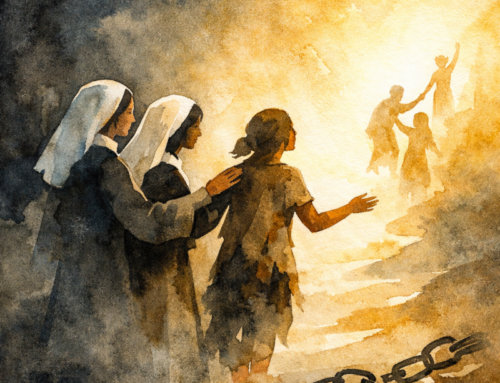
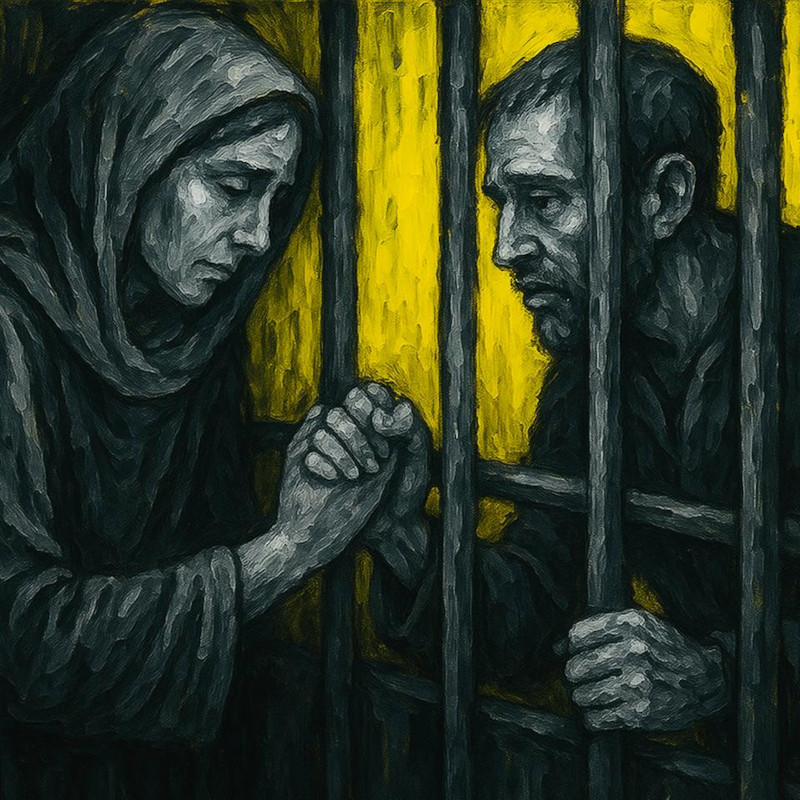
Image
- Image digitally created by spazio + spadoni
Biblical scholar Carlo Miglietta's commentary on the sixth corporal work of mercy: Visiting the prisoners
The situation
Around the world, hundreds of thousands of people are in prisons, often completely innocent, but inconvenient to the regime in charge, treated with inhumanity, violence, and sometimes torture.
In Italy, as of June 30, 2024, the number of inmates in Italian prisons was 61.480, an increase of 1.314 compared to the previous six months. Italian prisons are overcrowded, with an overcrowding rate of 119%, or 61.468 inmates for 47.067 places.
Il overcrowding It leads to a series of problems: cramped spaces, poor hygiene, difficulty in providing essential services, an increased risk of conflict and aggression, and the inability to offer rehabilitation and job placement programs.
Approximately 60% of those convicted have already served a prison sentence, indicating a problem of recidivism. Thirty-one percent of inmates are citizens of other countries. Women represent 4,3% of prisoners. Few inmates, 24%, are engaged in work, and only 34% attend educational courses. Six thousand inmates in our country have a serious psychiatric diagnosis, and fifteen thousand are using psychotropic drugs.
Adding the suicide in prison that occurred in 2024 and those that occurred between January and May 2025 bring the total to 124 cases, while at least 2.262 people were saved in extremis by cellmates or officers.
The prisoner is a person
Judge Rodolfo Venditti stated: "There is no such thing as a thief, but a person who has committed a theft; there is no such thing as a murderer, but a person who has committed a murder; there is no such thing as a rapist, but a person who has committed a rape, but has every chance of not committing another crime in the future." (Justice as a Service to Mankind. Reflections of a Magistrate, 1995 and 2017).
Many times Father Luigi Ciotti He stated that if we had lived in social contexts of some that we define as criminal, without affection, without education, without positive role models, perhaps we too would be worse than them.
He said Pope francesco to the inmates of San Vittore in Milan in 2017: “I don't have the courage to say to anyone in prison: "He deserves it." Why you and not me? The Lord loves me as much as you do, Jesus himself is in you and in me, we are sinful brothers." And again: "Jesus did not forget the prisoners either. By placing the visit to the prisoners among the works of mercy, he wanted to invite us, first of all, to don't let us judge anyone… Whatever a prisoner may have done, he remains loved by God. Who can enter into the depths of his conscience to understand what he feels? Who can comprehend it? pain and remorseIt's too easy to wash our hands of the situation by claiming they've made a mistake. A Christian is called, rather, to take responsibility for it, so that those who have made mistakes understand the harm they've done and come to their senses. The lack of freedom is undoubtedly one of the greatest deprivations for a human being. If we add to this the degradation caused by the often inhumane conditions in which these people find themselves living, then a Christian truly feels compelled to do everything to restore their dignity.
But God “does not despise his own who are prisoners” (Ps 68:34), “he brings out the prisoners with joy” (Ps 67:7), “he frees the prisoners” (Ps 145:7), “he leads back the prisoners of Zion” (Ps 125:1), “he rescues my life from prison” (Ps 141:8).
And Jesus declares himself to have come for "to proclaim the liberation of the prisoners…, to set at liberty those who were oppressed” (Lk 4:18; cf. Is 61:1; 42:7; 49:9): “Therefore it is written: ‘When he ascended into heaven he led captive with him’” (Eph 4:8; cf. Ps 67:19).
“One of Pope Francis's last public engagements was Holy Thursday, April 17, 2025, a few days before he died, when he went to the prison of Queen Coeli to meet the detained people.
It's an appointment the Pope had renewed every year. "I like to do every year what Jesus did on Holy Thursday: the washing of the feet in prison," the Pope had said.
During his tenure he frequently expressed concern about the conditions of detention, even asking for clemency measures for the detainees. (P. Gonnella).
On December 26, 2024, Pope Francis had wanted to open the Holy Door in the church of Our Father, inside the Roman prison of Rebibbia with a gesture that made history: it was the first time that a pontiff opened a Holy Door not in a basilica but inside a penitentiary which, however, as he himself declared, for one day became a "basilica" itself.
"I," the Pontiff commented, "wanted to throw open the Door today, here. I did the first one at St. Peter's, the second one is yours. It's a beautiful gesture to throw open, to open: to open the doors. But more important is what it means: it is open your heartClosed hearts, hard ones, do not help us live, that's why the grace of a Jubilee is to throw open, to open, and above all, to open hearts to hope. I wish you much peace, much peace. And I pray for you every day." And, in his will, he donated two hundred thousand euros to prisoners, as a concrete gesture of solidarity and help.
Jesus in prison
Pope Francis said: “Let us not forget that Jesus and the apostles also experienced prison. In the accounts of the Passion we know the sufferings to which the Lord was subjected: captured, dragged like a criminal, mocked, scourged, crowned with thorns… He, the only Innocent One! And Saint Peter and Saint Paul were also in prison (cf. Acts 12:5; Phil 1:12-17)… The passage from the Acts of the Apostles which recounts Paul's imprisonment is moving: he felt alone and longed for one of his friends to visit him (cf. 2 Tim 4:9-15). He felt alone because the great majority had left him alone… the great Paul.”
Said the Cardinal Zuppi“Prisoners are the least of Jesus’ brothers.”
What can we do?
There are many voluntary associations who enter prisons to assist chaplains, the few psychologists, and social workers. Every parish, group, and movement should support these associations by providing clothing and personal hygiene items to needy inmates, by allowing inmates to visit, by corresponding with them, by creating shelters where inmates can spend their probation, by integrating inmates into the workforce after their sentences, or by providing them with housing.
With the same charity with which the Good Samaritans, in the days of Ahaz, king of Judah, “they began to feed the captives; they clothed all who were naked and shod them with garments from the spoil; they gave them food and drink and anointed them with lotions. Then they carried on donkeys those who were unable to walk and brought them to their brothers at Jericho, the city of palm trees. Then they returned to Samaria” (2 Chronicles 28:15).
“But beyond the possibility of “entering” prison as a gesture of solidarity, the question arises in cultural termsAre we capable of acknowledging the burden of loneliness and humiliation, of remorse and desperation, of those who live in seclusion, and trying to bridge an abyss that only acceptance and closeness can somehow make our own? We are able to question ourselves "What measures will be able to make the transgressor aware of the evil he has committed? Can we imagine what processes will generate a reconciliation between the "victim" and the "executioner"?" (R. Davanzo).
Each one must ask himself how to obey the command of the Word of God: “You shared in the sufferings of those in prison and joyfully accepted the plundering of your possessions, knowing that you yourself possessed a better and more enduring possession” (Heb 10:34); “Remember those in prison, as if you were fellow prisoners, and those who suffer, since you yourselves also are in the body of man” (Heb 13:3).
Image
- Image digitally created by spazio + spadoni
Visiting the prisoners