



 Italy
Italy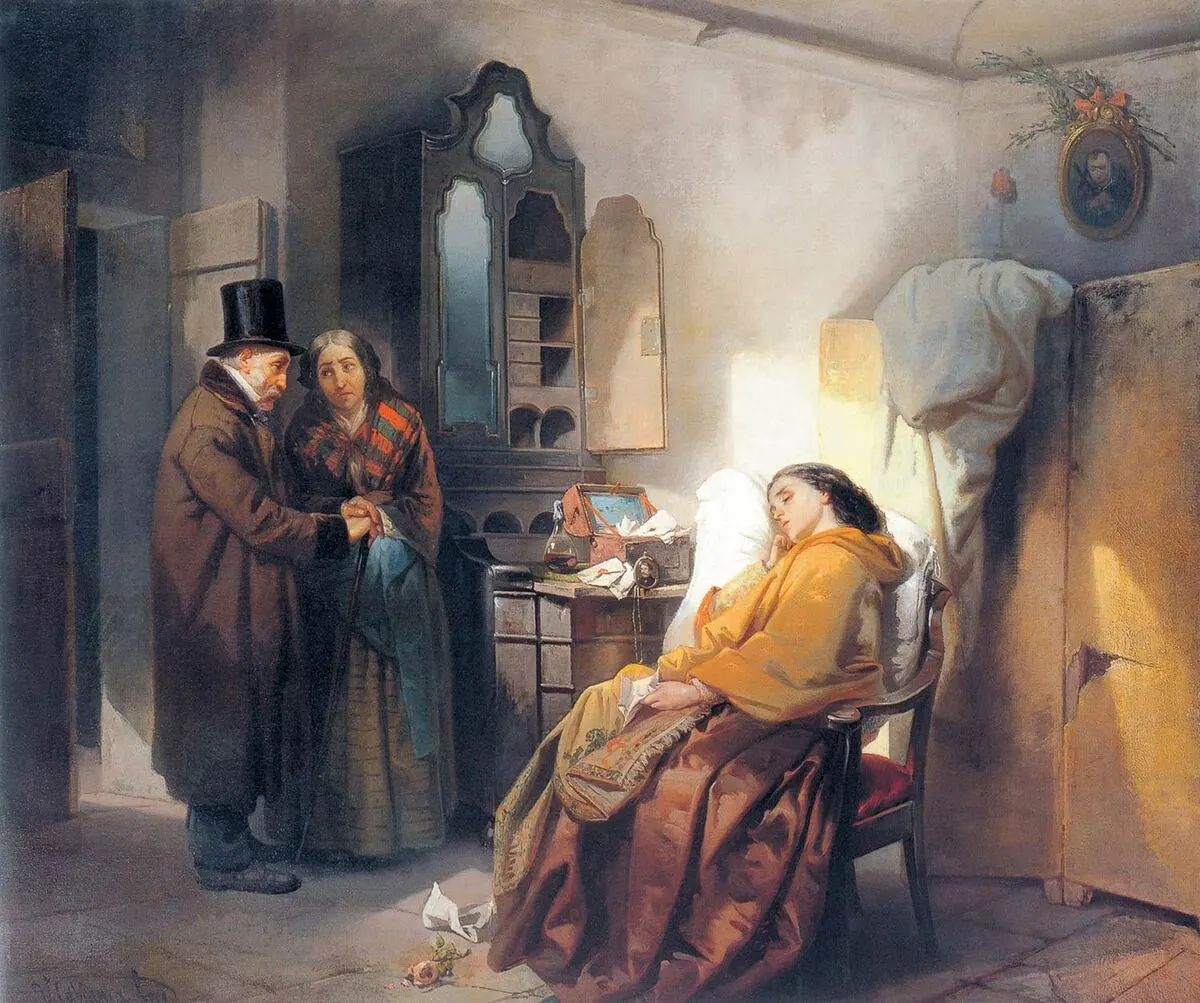
The spiritual Work of Mercy «comfort the afflicted» seen through different artists.
This spiritual Work of Mercy aims to lift man out of affliction, which is a particular state of pain in which the human soul can find itself.
Vincenzo Cabianca
He is one of the best-known Tuscan Macchiaioli (lived between 1827 and 1902) and painted the canvas «The Abandoned Woman» in 1858, expressing better than words the unease and the inability, at times, to take action to comfort the afflicted.
Everything takes place in a setting typical of modest provincial homes, humble yet dignified, where a grief-stricken woman surrenders to her affliction, while in a corner of the room an elderly mother and an educated visitor question each other with their eyes because, as often happens, they do not know how to intervene in such situations.
The play of light and shadow, with warm alternating tones, makes the sorrowful condition of the figures all the more palpable.
Giorgio Vasari
Certainly the Gospel speaks several times of Jesus’ affliction—over Lazarus, over Jerusalem, over the hardness of the human heart—and among these, Jesus pausing to comfort the women following him toward Calvary.
Vasari (1511–1574), a remarkable Renaissance writer, architect, and painter, created a grand depiction of this episode in Santa Croce, Florence. The figures are arranged tightly without space between them, without perspective, in an overlapping of violent gestures, grim faces, and gleaming armor that captures the sheer drama of that moment.
On one side he places the pious women who, moved by merciful charity, follow him and support his sorrowful Mother. Among them, Veronica approaches him to wipe his face: Jesus pauses to comfort and is comforted by that tender gesture of love.
Jesus, moved and surprised by such kindness, looks at the woman wiping his face and has words of comfort for the others who surround him, helpless and sorrowful—words and glances, small acts of mercy, that seem to silence the clamor of human cruelty.
Silvestro Lega
Silvestro Lega (1826–1895), one of the most prominent Tuscan Macchiaioli, remained poor throughout his life despite leaving behind an artistic heritage of great value, such as the painting «The Visit».
The families who hosted him on the outskirts of Florence enabled him not only to work, but also to observe and immortalize those moments of daily life offered by the Tuscan landscape and its people. «The Visit» is a glimpse into how a sorrowful moment of everyday life is experienced with a simplicity that becomes solemn.
Here the lady of the house, dressed in black indicative of mourning, walks toward two young sisters who greet her affectionately, while the girls’ mother prepares to join the group.
The atmosphere is wintry: the cold, sharp air of the landscape and the bare trees of the small garden convey the grief that has struck the mistress of the house. The measured restraint of the figures makes us understand how welcome is the comfort received from close friends who go to meet those in affliction.
Great too was the artist’s affliction when members of the family who hosted him died one after another of tuberculosis, yet the comforting friendship of families and friends proved decisive in offering him shelter and support. Thanks to them, the author regained his creative vigor, but contracted an eye disease and, after leaving behind magnificent masterpieces, died of stomach cancer in 1892, cared for and comforted until the end by his friends.
Today, we too encounter situations of misfortune, anguish, and suffering, and this cannot leave us indifferent. Great heroic gestures are not required of us, but God’s mercy can always triumph over everything, even through a word of comfort, a small material gesture, or a friendly visit to someone alone with their grief.
Photo: Wikipedia

Being Witnesses of Mercy – ILLUMINATE
2 February 2026