



 Italy
Italy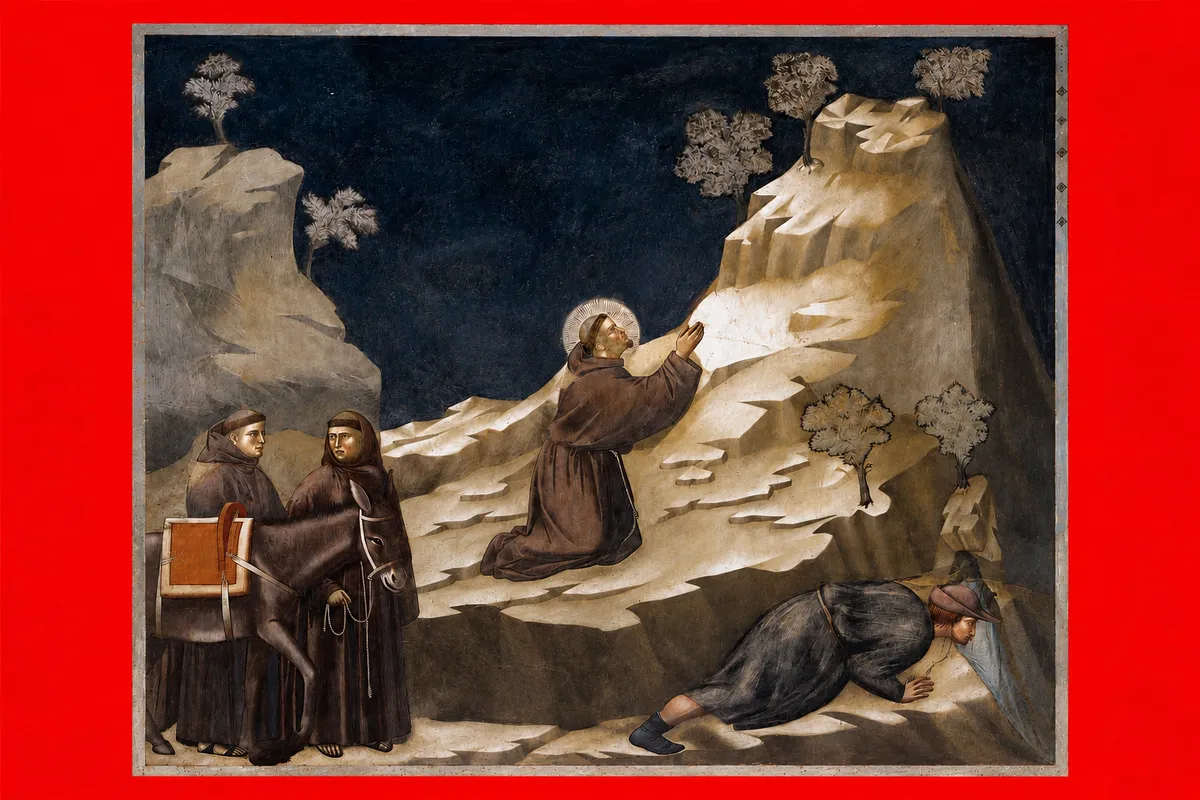
Tintoretto: thirst in the desert and the miracle of Moses
Jacopo Robusti (Venice 1518–1594), known as Tintoretto, a great Italian painter, already during his formative artistic years preferred to develop grandiose compositions where numerous figures were arranged within complex architectural settings and scenic backgrounds.
Thanks to his evident painterly skills, he was soon chosen to decorate the Scuola Grande di San Rocco in Venice. One of the primary duties of the confraternity was to relieve the thirst of the city’s poor, and it was precisely on the ceiling of one of those halls that he painted the scene of Moses striking water from the rock around 1577.
At the center of the scene, Moses raises his staff and strikes the rock from which a powerful stream of clear water gushes forth. Below, people and animals crowd together in their thirst with various containers to draw that water. Moses, a man of powerful physique signifying his spiritual strength, looks trustingly upward where, amidst the clouds, His face partly hidden by heavy vestments, God permits the miracle and above all allows this fickle people, despite everything, to quench their thirst. The true protagonist therefore becomes God, who does not hold sins against them, but shows mercy and grants grace to Moses who interceded and persevered in his prayers. The contrasts of light and shadow emphasizing the figures’ movements and expressions, the vivid chromatic tones, and the evocative background heighten the tension and dramatic power of the biblical episode. In contrast to Tintoretto’s restless and tormented vision stands the calm, balanced, and serene depiction by another major Italian painter.
Paolo Veronese: the encounter between Jesus and the Samaritan woman at the well
The Venetian painter Paolo Caliari (1528–1588), known as Veronese, is credited with one of the finest masterpieces illustrating the well-known episode of the encounter between Jesus and the Samaritan woman (1585).
Preserved in one of Vienna’s most prestigious museums, this work is profoundly significant and fully captures the fundamental core of the Gospel passage: dialogue.
Jesus has just arrived at the well, and the woman, in brightly colored attire, seems to have just arrived as well. In the background lies the charm of fresh, lush nature, where the apostles can be glimpsed in the distance returning with food.
Eloquent is the gesture of Jesus who, thirsty and weary, asks the woman for a drink while she prepares to fill her jug. Thus begins the dialogue between the Son of God come to save and a person perhaps most despised by her community, entangled in her sins.
Christ, through the profound goodness born of mercy, leads her to reflect upon her troubled emotional life, her struggles, and her false idols. He brings her to an awareness of her state and reveals the Truth that will transform her life: «I know that the Messiah is coming. I am the Messiah». Incredible though it may seem, many Samaritans of that city came to believe in Him through the woman’s testimony and words. In this painting, the gentle expression on Christ’s face and the young woman’s attentive listening are enveloped in delicate chromatic richness, where tonal gradations enhance the beauty of this encounter of merciful love.
Giotto: Saint Francis and the miracle of the spring in Assisi
In the 14th century, painting played an essential educational role, so much so that this work of mercy was interpreted by Giotto di Bondone (1267–1337), Florentine painter and architect, in the «miracle of the spring», one of the twenty-eight frescoed panels for the Upper Basilica of Assisi.
Descending from the hills of the Bargello, the artist visited Assisi for the first time, having apprenticed under Cimabue. There he came into contact not only with accomplished Roman painters, but above all with the local friars, establishing a strong rapport and gradually coming to deeply revere the founder of the order: Saint Francis.
Giotto thus became the master narrator interpreting in a compelling manner what the friars preached: poverty, prayer, and above all mercy. This clarifies why the friars of Assisi, merely seventy years after the saint’s death, commissioned him to execute the Basilica’s grandest pictorial cycle.
The thirsty man in the scene is not quenched directly by the saint; he is placed in the lower right corner because the viewer’s focus is directed toward what the saint does: he prays!
The dominant figure is Saint Francis who, moved with pity for the severe thirst of the youth accompanying the friars, halts and kneels upon the rocks to implore God’s mercy. The setting features two bare, rocky mountains and sparse trees highlighting the barrenness of the land, accentuating the extraordinary event of water suddenly bursting from the rock.
In the foreground to the left, two friars with a donkey look at each other—one surprised, the other rejoicing at the miracle taking place before them. Lower down on the right, the thirsty youth, braced on one foot, is entirely focused on slaking his thirst, oblivious to the miraculous work unfolding above him.
The artist, here as in other panels, conveys the religious message brought to the world by exalting love for creation—the earth, water, animals, and humanity through which the presence of God is recognized.
The colors are selected with masterful genius, such as the large blue triangle of the sky pointing like an arrow toward the saint’s head.
The entire composition is structured by contour lines, alternating thin and thick, defining volumes and conveying the psychological responses of the figures: Saint Francis serene and trusting, the friars astounded, and the youth eager for relief.
The scene demonstrates that the true author of the miracle is God who, in His great mercy, answers the saint’s prayer, restores the thirsty, and strengthens the faith of the humble friars.
From artistic contemplation to daily action
These magnificent depictions must not merely be admired; they must lead us to reflect and act. Today it is not required to bring water forth from rock, yet it is simple to practice this work of mercy toward those reaching out their hands, particularly in forgotten regions.
Cover image: The Miracle of the Spring 14, by Giotto (Wikipedia)

Being Witnesses of Mercy – ILLUMINATE
2 February 2026