


 Italy
Italy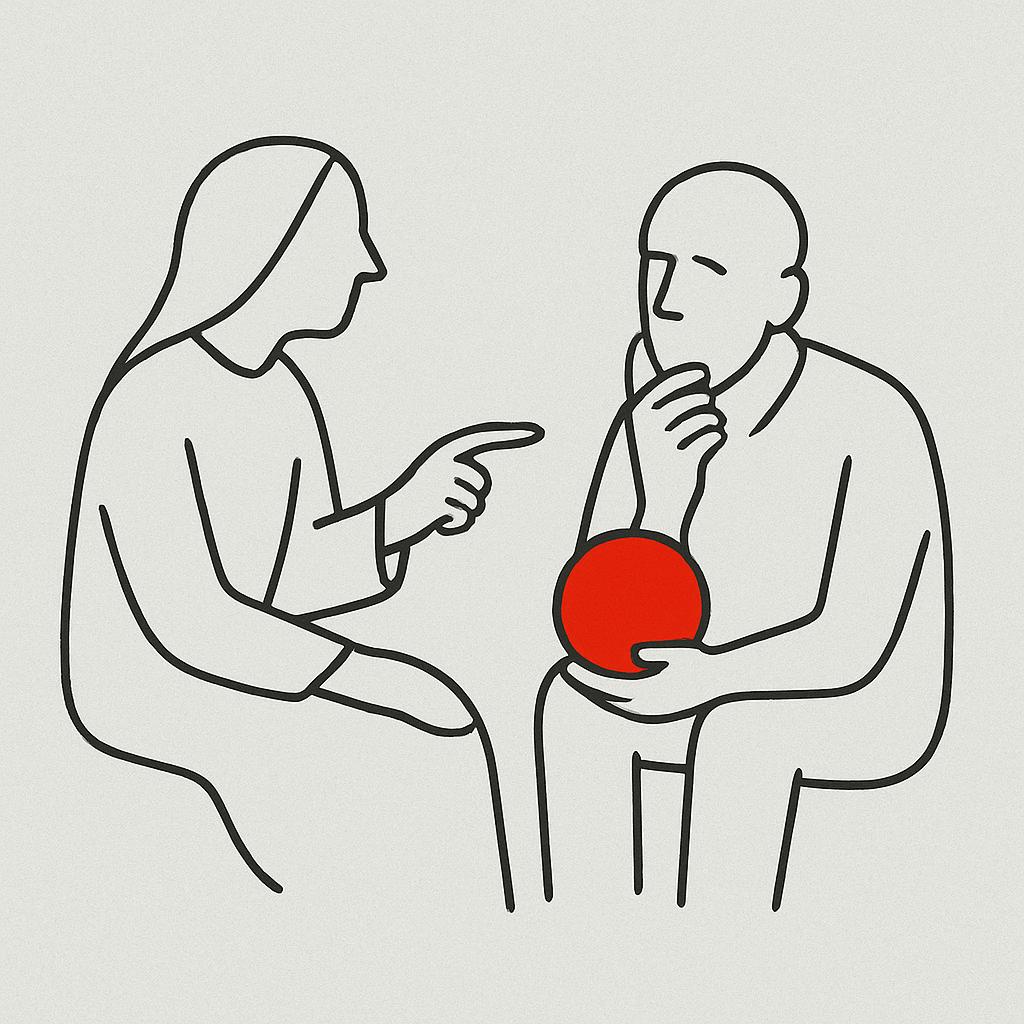
From the website of the Ufficio Nazionale per la Pastorale della Salute della CEI, a reflection on the first spiritual work of mercy
(Dr Paola Geraci, Diocesan Director for Health Pastoral Care in Palermo, 2016)
The works of mercy?! I believe that, if we interviewed people outside many churches as they left Sunday Mass and asked what they are, we would not receive a high percentage of correct answers, because I think that even though we practise at least some of them, we do not recognise them as such and their names have been lost in the memory of an old catechism. Unless a Pope comes along and proclaims the Jubilee of Mercy: now we will hear a great deal about them and be encouraged to make them become “life lived”, “a concrete experience of merciful charity”.
Having spent more than thirty years at the Obstetrics and Gynaecology Clinic of the University in my city has “exposed” me to countless opportunities to experience what, “technically speaking”, is a spiritual work of mercy: counselling the doubtful.
I like to recall that, when choosing the medical profession and above all my specialisation, I was the one who had doubts and sought someone who could advise me. What criterion guided me? Through a personal encounter with the Word of God, I tried to understand his will for me and then sought someone with experience in the matter, as Sirach 37:7–16 says.
I asked to meet with my secondary-school religious education teacher and an uncle who was a doctor: in them I believed I would find both “lines” of reflection. One was a person who could guide me in recognising God’s will for my life, as I was beginning to understand that professional choices had a vocational dimension; the other was a person who, by practising medicine, could show me the advantages and disadvantages of this reality, which he seemed to live in a way that was “fascinating” to me and my other cousins. My uncle had no children, but 7 of his 14 nieces and nephews became doctors.
I have been approached countless times by patients and their relatives who, when faced with problems concerning life and health, felt the need to voice their doubts, recognising in me someone with expertise in both “lines”.
Among the works of mercy, the one on which we are reflecting is the only one with a specific and direct reference to the Holy Spirit, in the sense that “counsel” is named among the gifts of the Spirit.
The sphere in which the spiritual works of mercy—and this one in particular—are practised is, first of all, the sphere of faith, the sphere of “divine things” (to use a term that no longer finds a place in modern language), in order to help people live with a concrete and conscious adherence to the truth that “the Church proposes for our belief”.
Today’s liquid society, however, raises doubts at every turn; indeed, there is a widespread belief that the more doubts a person has, the more modern they are. It would seem that Descartes’ famous phrase “cogito ergo sum” has become “dubito ergo sum”, with the resulting increase in fragility: the “liquid” grows and spreads, and the person becomes increasingly liquefied. And with the person, all certainties as well!
If a person has certainties—and many people in our world still do—they are attacked by prevailing thought, which attempts to gnaw away at their roots with questions such as “What is wrong with it?” and “If it can be done with the means now available through technology, why not?”
Thus, counselling the doubtful is a strong support, a restorative treatment, often given “in small doses” in situations of some urgency, recalling those roots that risk remaining hidden underground and no longer able to support the tree of firm convictions, so as to strengthen them.
At times, for fear of being labelled fundamentalists, we risk remaining silent and failing to offer help. Having firm convictions does not mean being an extremist; it means having beliefs that enable us to face life’s storms and the increasingly widespread and invasive waves that attack what is fundamental: life, human dignity, health and family.
An unexpected pregnancy or a pregnancy in an “irregular” situation, a prenatal diagnosis of foetal malformation, infertility within a couple, or advanced illness generate serious doubts that overwhelm those directly involved and those around them.
In these situations, which I have experienced countless times, I have invoked the Holy Spirit, the giver of Counsel, first of all to have the right attitude, which Jesus teaches us: «they worshipped him; but some doubted. Then Jesus came to them and said…» (Mt 28:17–18).
In this Gospel image, I distinguish two moments. First: we see those who bow down to worship the Lord, but only with their bodies, and doubt that he is the Lord of their lives, to whom they can turn at all times, especially difficult ones. Doubt winds through them, discouraging them from entrusting themselves to the Lord, and they remain on an anguished seesaw that prevents them from choosing what is good. Second: an excellent lesson in the method to follow. Jesus does not rebuke them but draws near and speaks. Here is the search for the right words, which we must ask of the Holy Spirit, so that through those syllables Counsel—with a capital letter—may pass, bearing within itself the power to erase doubt and lead us towards unconditional trust in his love. Yes, because at the root of everything lies our response to the Father’s love and the offering of love to our brothers and sisters in Jesus, sustained by the power of the Holy Spirit, who gives us Counsel.
It is not always easy to do all this, because we come up against a widespread mentality, regarding which Saint Paul exhorts us: «Do not conform yourselves to this age, but be transformed by the renewal of your mind, so that you may discern the will of God, what is good, pleasing to him and perfect» (Rom 12:2).
When faced with well-known and unfortunately widespread questions such as «What is wrong with it?» «Can God condemn me because I desire a child?» «Why me? What have I done to God?» counsel supports us in bearing witness to the truth. This is in an age when a culture that values shifting opinions prevails, promoted by figures who have even been given a title, “commentators”, modern masters of “do-it-yourself” truth. To them, the Church continues to show the light of Truth, which has a power of attraction for those who approach existential questions with an upright heart […].
(Text written in November 2016)
Image digitally created by spazio + spadoni
Source: National Office for Health Pastoral Care of the Italian Bishops’ Conference
Being Witnesses of Mercy – ILLUMINATE
2 February 2026