



 Italy
Italy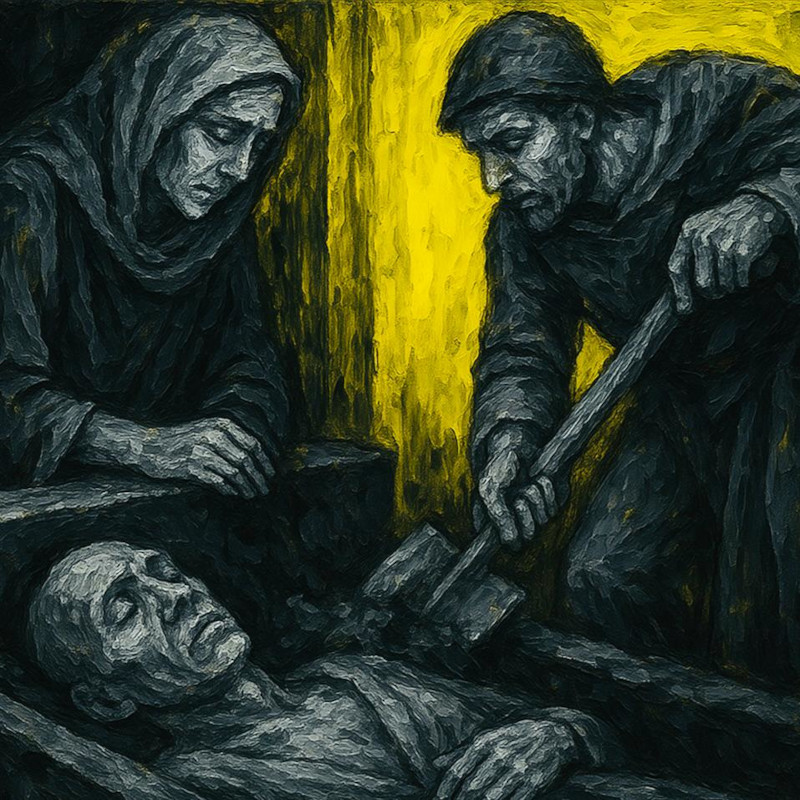
The Church does not affirm the immortality of the soul, but in its “Creed” proclaims: “I believe in the resurrection of the body, and life everlasting” (Apostles’ Creed); “I look forward to the resurrection of the dead and the life of the world to come” (Nicene-Constantinopolitan Creed), as stated in the Second Reading (1 Cor 15:20-26).
Thus the Catholic Church proclaimed with Pius XII in 1950 the Assumption of Mary body and soul into heaven, as a prototype of all believers. Saint Justin stated: “When you meet someone who calls himself a Christian, ask him: «Do you believe in the resurrection of the dead or in the immortality of the soul? If he answers: “The immortality of the soul”, he is not a Christian»”.
Enzo Bianchi states: “It seems that the resurrection of the body, the resurrection of our bodies, is the «strangest thing» that the Christian faith asks us to believe. It is no coincidence that sociological analyses conducted on the faith of Italian Catholics show that, while the majority of the population believes in God, not even 20% believe in the resurrection of the body… When one listens to what Christians think about the afterlife, one is often left embarrassed. They often speak of reincarnation (an expression unknown until a century ago and introduced with the phenomenon of spiritualism)… These Christians, who often view reincarnation as an Eastern religious belief, do not realize that in Hinduism and Buddhism reincarnation is seen as a condemnation, because salvation is achieved precisely by escaping the cycle of rebirth!”.
Biblical revelation, on the contrary, is a hymn to corporality, called to redemption and resurrection. Paul announces the resurrection not as required by a presumed immortality of the soul, but by God’s love for humanity: “The body is not meant for sexual immorality, but for the Lord, and the Lord for the body” (1 Cor 6:13). It is an awe-inspiring concept: God Himself loves and sanctifies our body, called to immortality, a member of the body of Christ, a “temple of the Holy Spirit” (1 Cor 6:13-19).
Certainly, in eschatology our bodies will be transfigured, free from sickness and death: “So will it be with the resurrection of the dead: what is sown is perishable, it is raised imperishable; it is sown in dishonor, it is raised in glory; it is sown in weakness, it is raised in power; it is sown a natural body, it is raised a spiritual body” (1 Cor 15:42-45). But they will be our bodies! Just as the accounts of the appearances of the Risen Christ emphasize, there is profound difference between Jesus’ body before the resurrection and His risen body (He passes through closed doors: Jn 20:19), but there is also true continuity (He can be touched: Jn 20:20-27; He eats with His disciples: Lk 24:41-42; Acts 10:41).
“We know that already in the New Testament, at the beginnings of the Church, faith in the resurrection of the body was disputed: the Christians of Corinth struggled to accept this proclamation – as Paul testifies (1 Cor 15) – and the Apostle or his disciples always had to warn against those, like Hymenaeus and Philetus, who claimed that the resurrection had already taken place with baptism and was merely a spiritual fact (2 Tim 2:16-18). Humanly incredible though this universal event may seem, it stands at the very heart of Christian hope: will bodies dissolved into dust, reduced to seeds, be able to rise again…? Yes, proclaims the Christian faith, with its vision of blessing and divine affirmation of the body and matter. Our God chose to become man; the Word of God became sárx, flesh, and dwelt among us (cf. Jn 1:14), and now our fragile, mortal humanity is transfigured for eternity… Yes, Job’s longing is faith for us Christians: «This flesh of mine shall see the Savior» (Job 19:26-27)” (E. Bianchi).
Burying the dead
In the Old Testament, we have many examples of respectful burial of the bodies of the deceased: Abraham burying Sarah (Gen 23:6); Joseph burying his father Jacob (Gen 50:7,14); Tobit burying the dead at the risk of his own life, fleeing as his goods were confiscated by King Sennacherib (Tob 1:17-20); and upon returning home, fearlessly resuming this Work of Mercy amidst the astonishment and mockery of his neighbors (Tob 2:1-9).
In the New Testament, a woman—a sinner according to Lk 7:37—anoints Jesus with fragrant oil in Bethany, and Jesus exclaims: “In pouring this ointment on my body, she has done it to prepare me for burial” (Mt 26:6-16); Joseph of Arimathea gave his own tomb to Jesus and dared to approach Pilate to request the body of Jesus (Mt 27:57-60); Nicodemus brought a mixture of about seventy-five pounds of spices to anoint Jesus’ body (Jn 19:38-42).
This is why Scripture urges: “My child, let your tears fall for the dead, and as one in deep sorrow begin the lament; bury the body according to prescribed ritual and do not neglect the grave” (Sir 38:16).
The pastoral care of grief
Every parish community needs a team prepared to accompany funeral rites, guiding the relatives of the deceased through moments of bewilderment and sorrow. All too often, commercial funeral homes tend to take control of death, turning it into a consumerist and often spectacularized event.
Yet the believer knows that death must be lived in faith, and that only the Resurrection of Jesus gives meaning even to dying, opening the door to truly eternal life. Hence the vital importance of prayer—first at home or in the hospital, led by a family member or community member, then in the funeral vigil or Rosary, up to the closing of the casket and the Order of Christian Funerals.
A funeral is not a celebration of the earthly achievements of the deceased, but a solemn proclamation of the Paschal Mystery of Jesus who, through His Resurrection, raises us up with Him. As Archbishop Cesare Nosiglia of Turin wrote in the Diocesan Document “Proclaiming life at the hour of death”: “To avoid turning the celebration of the Paschal Mystery into a mere commemoration of the deceased, eulogies and personal speeches are not permitted at the time of final farewell.
Any written texts, submitted beforehand to the Christian community, should be read at the beginning before entering the liturgical celebration, or at the prayer vigil preceding the funeral rite, or in the church courtyard afterward, or at the cemetery prior to burial. In no case should the ambo be used for this purpose, as it is reserved exclusively for the Word of God and the Church’s prayer…
When the rite is carefully prepared in all its aspects, involving the family as much as possible, the pastoral team can gently handle requests from relatives and acquaintances to place foreign secular symbols on the casket, introduce secular songs outside the liturgy, or give personal tributes. The Church restricts such additions solely to let the symbols and words of Christian faith shine forth, toward which the entire celebration is directed”.
Funerals featuring caskets draped in football banners, profane poems, worldly playlists, and stadium-like applause are entirely misplaced. A funeral must proclaim the distinct core of Christian hope: that only in the Risen Christ is death defeated and life everlasting! It is an act of entrusting the deceased to God’s Mercy, in the blessed moment when God welcomes them into His Kingdom of eternal joy.
Cremation is not forbidden by the Church, provided it is not chosen for reasons contrary to Christian doctrine, such as a denial of the resurrection of the body. In cases of cremation, the Church accompanies with prayer the delicate moments of farewell and the committal of the urn in a cemetery.
However, the Church opposes the scattering of ashes because it «prevents the possibility of expressing personal and community grief in relation to a specific place. It also makes remembering the dead more difficult, extinguishing it ahead of time. For future generations, the lives of those who came before them disappear without a trace» (Order of Christian Funerals, n. 165). Due to this communal dimension of every person, the Church also opposes keeping ashes in private homes.
Finally, the family of the deceased must not be abandoned after the funeral. Those involved in grief pastoral ministry must provide real community closeness, supporting families emotionally and practically through the bureaucratic, social, and economic difficulties that bereavement often brings.
“Through the collaboration of everyone involved in funeral ministry, we are convinced that, even amid the trials of a secularized world, the good news of a communion greater than separation, of a life stronger than death, will break through” (Archbishop C. Nosiglia).
Image created digitally by spazio + spadoni
Being Witnesses of Mercy – ILLUMINATE
2 February 2026