



 Italy
Italy
The corporal work of mercy “burying the dead” seen through the paintings of several artists.
“A burial at Ornans” by Courbet
It is a funeral that Courbet, a French painter at odds with the idealist academic tradition of his time, presents to us in his monumental painting (6m x 3m) from 1849, preserved in the Musée d’Orsay.
This is usually how the burial of a deceased person begins, and Courbet (1819-1877), to create it, portrayed around fifty people from his hometown of Ornans, seeking to identify the various attitudes that typically characterize participants in funeral rites.
Here, they are all ordinary people, much like the deceased whose coffin is barely visible, covered with a white sheet near an open grave, alongside a skull and a crucifix that almost timidly overlooks the gathering. The colors are earthy, dark, and thick; the diffuse, indefinite light highlights the physicality of the figures arranged in a single horizontal mass, surmounted by a yellowish tone that blends into the grey-green sky.
Regarded as the pioneer of realism, Courbet faced severe criticism, especially for this painting, which was dismissed as an homage to vulgarity and ugliness because it decisively rejected the ideals of classicism and romanticism.
Furthermore, it presents reality as it is without embellishments, in stark contrast to the bourgeois sensibilities of the era, bluntly demystifying the sacredness of the ritual.
Indeed, Courbet examines the psychology of the figures and, just as happens today, captures the chatter of some, the lack of real grief, those turning around to watch others, and those attending purely out of convention.
Unaware of what is truly taking place are the altar boys asking for explanations or remaining indifferent, much like the priest performing the rite with detached solemnity.
Standing out in the crowd set against a rugged landscape are the priests conspicuously clad in red, the dark clothing, the white bonnets of the women, and a stray dog approaching the gathering, revealing the raw realism of a common human event.
“The entombment”, better known as Lamentation over the dead Christ, by Rubens
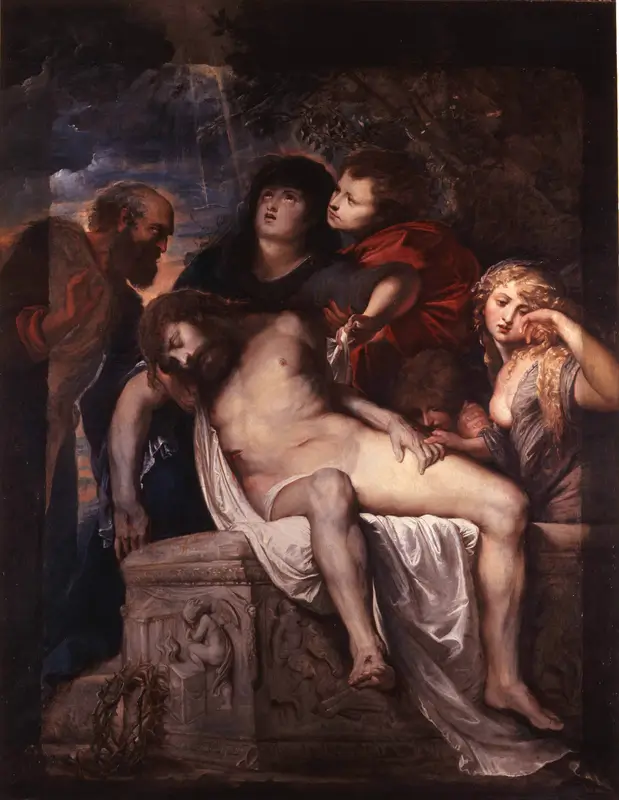
Of an entirely different spiritual intensity is the “burial of the body of Christ” painted between 1602 and 1606, now in the Galleria Borghese, by Flemish master Peter Paul Rubens (1577-1640).
Here too, the artist undertakes a meticulous psychological study of the figures; however, they display a profound, heartfelt involvement in the event, drawing the viewer directly into the tragedy of death.
Rubens greatly admired Caravaggio’s painting on the same theme and, one year after Caravaggio’s death in 1610, reinterpreted it in Antwerp, far from the original masterpiece.
The son of Protestants, Rubens converted to Catholicism at age 14, began his apprenticeship in local workshops, and was later appointed master of the Guild of Saint Luke in Antwerp. He soon received prestigious commissions from the nobility of France, Spain, and Italy, and passed away in Antwerp.
In this work, Rubens places a dark arch above as a symbol of death, portraying Christ as a heavy human body being lowered into the tomb with physical exertion.
Lowering him is the young Saint John, who simultaneously supports the sorrowful Virgin Mary as she raises her eyes toward heaven, as if seeking divine strength to endure such an agonizing and painful task. Christ, bathed in intense light, shows the bruises of torture, while the elderly man on the right may represent Nicodemus with the features of Saint Philip Neri.
With a furrowed brow, he seems to reflect the logistical and emotional weight of carrying out the burial.
The light falls decisively upon the serene face of Christ and Mary Magdalene, shown in an almost unrestrained posture—perhaps evoking her past—while leaving other figures in partial shadow to emphasize the tragedy and honor the deep grief shared by all present.
The entire drama is softened by warm colors contrasting with muted darks, set against the pale white of Christ’s body and the shroud, rendering the tragic moment profoundly touching.
“Blessing of the dead of the sea” by Lorenzo Viani
Burying the dead is undeniably a difficult work to fulfill, and especially in recent times, it is often the sea that receives this burden. How often do we hear of victims claimed by the sea: fishermen or migrants.
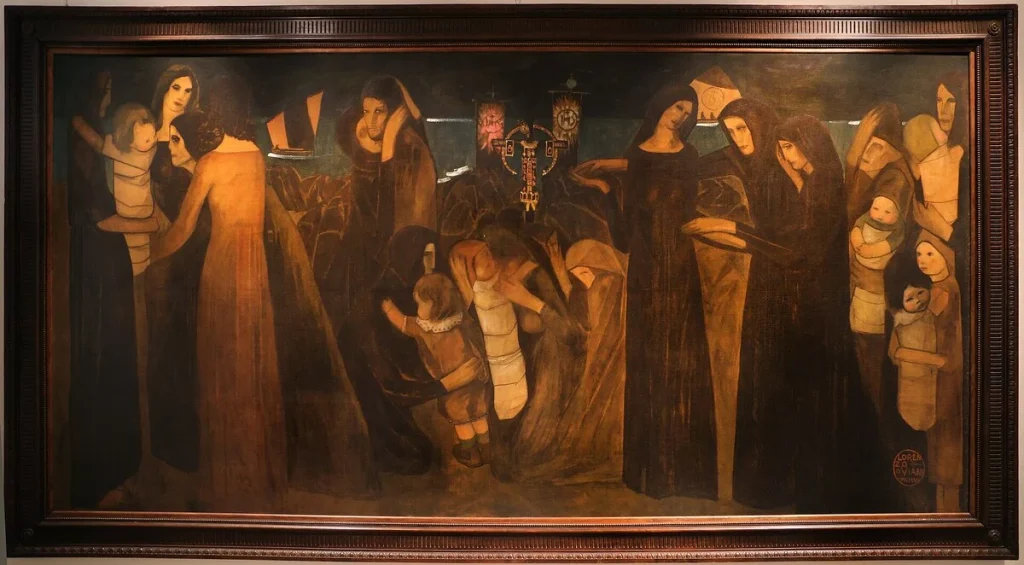
Lorenzo Viani, a renowned contemporary painter from Viareggio, reflected precisely on this theme, leaving behind a deeply moving masterpiece: “Blessing of the dead of the sea” (1914-16), housed in the Viareggio Museum.
The true protagonist is the grief of the women standing together in resigned dignity, holding close their fatherless children. The solid black of their dresses accentuates their faces, etched into masks of sorrow, among which a youthful and tender countenance stands out, reminiscent of the Virgin Mary.
Black silhouettes against a slate-grey sea, rippled only by slight white crests, who waited faithfully, reciting the rosary for the return of loved ones they will never see again.
Traditions anchored in faith and marked by the unyielding passage of time are expressed by the artist through bold colors, flat volumes, and a rigidly geometric compositional structure.
The tragedy, the agony of waiting, the clasping of hands, the embrace of the survivor, and the gathering of children already resigned to their sorrow create overwhelming emotion.
Viani wrote: “the sea, an endless cemetery, was also blessed this morning at dawn… The families of the lost gather around the little chapel… the priest raises his arm and the blessing drizzles over the leaden sea.” Images and words poignantly capture the reality of this corporal work of mercy, calling everyone to deep reflection.
Cover image: Wikipedia
Being Witnesses of Mercy – ILLUMINATE
2 February 2026