



 Italy
Italy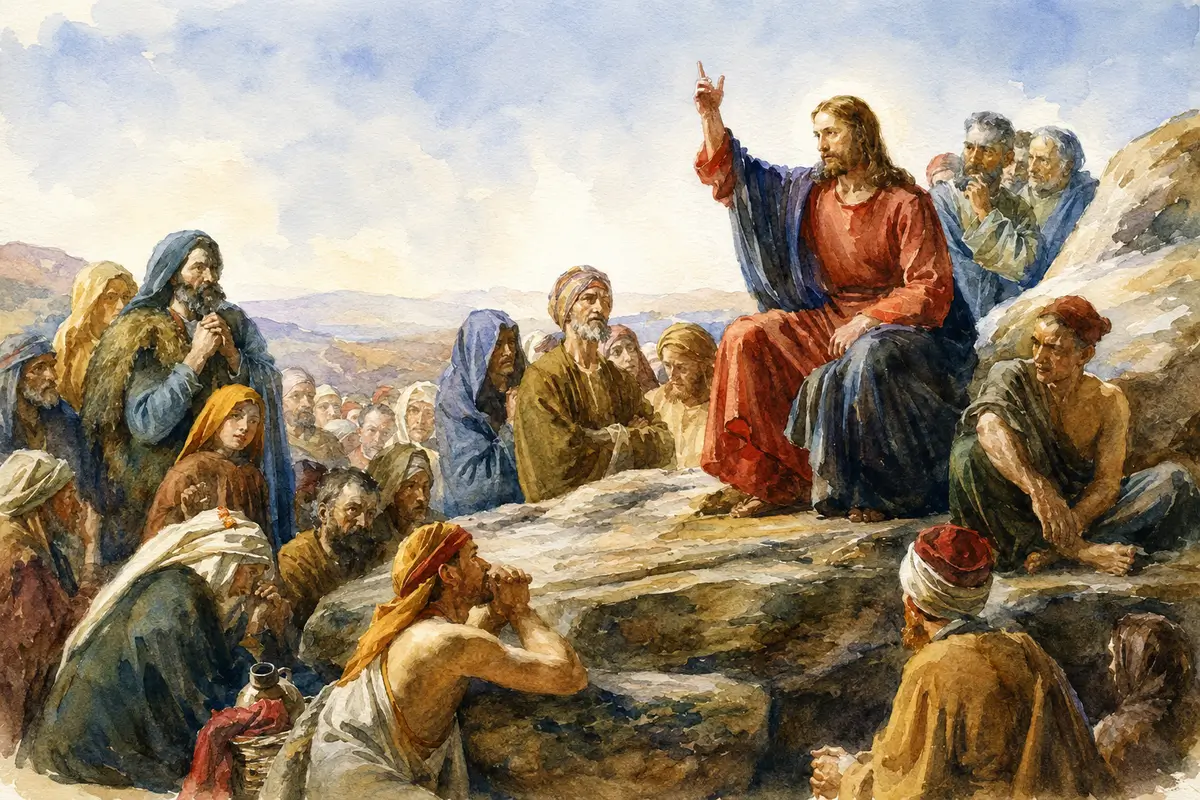
The spiritual Work of mercy “instructing the ignorant” seen through Bloch’s paintings and the fresco depicting Saint Frances Cabrini.
Jesus is undoubtedly the Teacher par excellence, always ready to teach merciful love through his words and witness. This has inspired many artists to depict key moments of the Gospel.
The paintings of C. H. Bloch: the Sermon on the Beatitudes
The cycle of paintings executed in Frederiksborg Castle near Copenhagen by Carl Henrich Bloch between 1865 and 1879, including the Beatitudes, is truly magnificent.
Carl was born in Copenhagen in 1834. A promising young student, he won a “travel grant” that allowed him to visit Holland, France, and Italy in Rome, where he met his future wife who bore him eight children and gave him the chance to meet the greatest artists of the era.
In his painting of the Sermon on the Mount, Jesus has ample space around him and sits upon the rocks as though in an academic chair; he raises his right arm pointing toward heaven and looks solemnly toward the crowd. Great is the attentiveness of the listeners, because great is the wisdom of the teacher. The Sermon on the Beatitudes is addressed to every individual as Jesus’s supreme teaching to humanity.
Here, the painter seeks to capture every thought moving the minds and hearts of those present through daylight clarity and bold, contrasting tones in foreground faces and figures, which gradually soften in the background to convey, like an echo, the boundless beauty of listening.
The fresco by Pasquale Arzuffi: Saint Frances Cabrini
During the years Carl was creating his paintings, a young Italian woman in delicate health, yet driven by an ardent desire to teach God’s mercy, was beginning to reveal her teaching gifts: Francesca Cabrini. Born in Sant’Angelo Lodigiano in 1850 and orphaned early in life, she obtained her teaching diploma and began teaching catechism to children despite opposition from civil authorities.
In Saint Francis Xavier this teacher found her ideal model of life, adopting his name when taking religious vows. By 1880 she had founded the Missionary Sisters of the Sacred Heart and had already embarked on numerous journeys to teach the ignorant and spread the mercy of God.
It was Pope Leo XIII who designated the West as the field for her apostolate. Thousands of Italian emigrants lived in Europe and especially in the United States, unacquainted with the local language and customs.
The dirty streets crowded with the poor and desperate became her first classrooms, as portrayed in a painting by Ciotti. She looked upon this plight with the heart of a great Christian mother and strived to build schools and boarding academies. High schools, festive oratories, hospitals, and medical clinics soon accompanied the meager provisions of the basic schools.
Impelled ever more by mercy, she and her sisters progressively dedicated themselves to prison ministry, recognizing education as the foundation for restoring human dignity. Another fine canvas by Cesare Secchi portrays her during wartime, traveling to Alaska to care for wounded soldiers and teach needlework and embroidery to their young daughters.
She was a mother to thousands of emigrants, directing headmistresses in her schools with the sweetness and peace learned from her Master Jesus.
The stained-glass windows of the church in Sant’Angelo Lodigiano depict milestones of journeys that saw her cross the ocean nineteen times, including crossing the Andes on muleback. In prayer she found answers to her grand initiatives and nourished her longing to teach and reveal merciful love.
From the United States she traveled to Nicaragua, Argentina, Peru, Chile, Spain, England, and Italy, before returning permanently to America.
She passed away among her emigrants in Chicago in 1917, and her body was later translated to New York at Mother Cabrini High School, close to her spiritual children.
Her life entirely devoted to teaching remains one of many radiant witnesses given by the Church to inspire us to instruct the ignorant in Christian wisdom and human dignity.
The fresco in the apse of the Basilica of Sant’Angelo Lodigiano, painted by Pasquale Arzuffi, reflects this community’s deep devotion to a humble woman and magnificent teacher who still teaches us mercy today.
Image created digitally by spazio + spadoni
Being Witnesses of Mercy – ILLUMINATE
2 February 2026