



 Italy
The spiritual work of mercy “Praying to God for the Living and the Dead”: From Millet’s Painting to Luigi Nono’s
Considering that Jesus, in his great mercy, has always prayed for all of us and still prays today, in his eternal time, praying for others is a charity of irreplaceable intercession for the living and the deceased.
The Angelus by Millet
Jean-François Millet (1814-1875), one of the leading exponents of realism, recounts: “This is a painting I made remembering the times when we worked in the fields and my grandmother, every time she heard the bell toll, made us stop to recite the Angelus in memory of the poor departed.”
The painting now preserved at the Musée d’Orsay in Paris bears the precise title of “The Angelus”, commissioned in 1857-1859 and greatly admired by Salvador Dalí. Born into a farming family, Millet was always drawn to rural life and peasants because of that sincere humility born from the conscious acceptance of their duty entrusted by God.
In this painting, the two peasants pause at the sound of the church bells of Chailly-en-Bière, which seem to mark the rhythm and flow of country life. Having set aside the wheelbarrow and pitchfork, the man removes his hat as if inside a church, while the woman bows lower to whisper her prayer.
The enchantment of contemplation is captured with rare intensity; everything is accentuated by a twilight glow emerging from the horizon, silhouetting the figures against the vast field where the distant profile of a church is barely discernible, imbuing the scene with high moral dignity and religious mercy toward others.
The Isle of the Dead by Böcklin
The mystery of memories mingled with grief powerfully evokes the concept of the cemetery as a sanctuary of silence and recollection, where one seeks to accept everything through prayer and Christian hope.
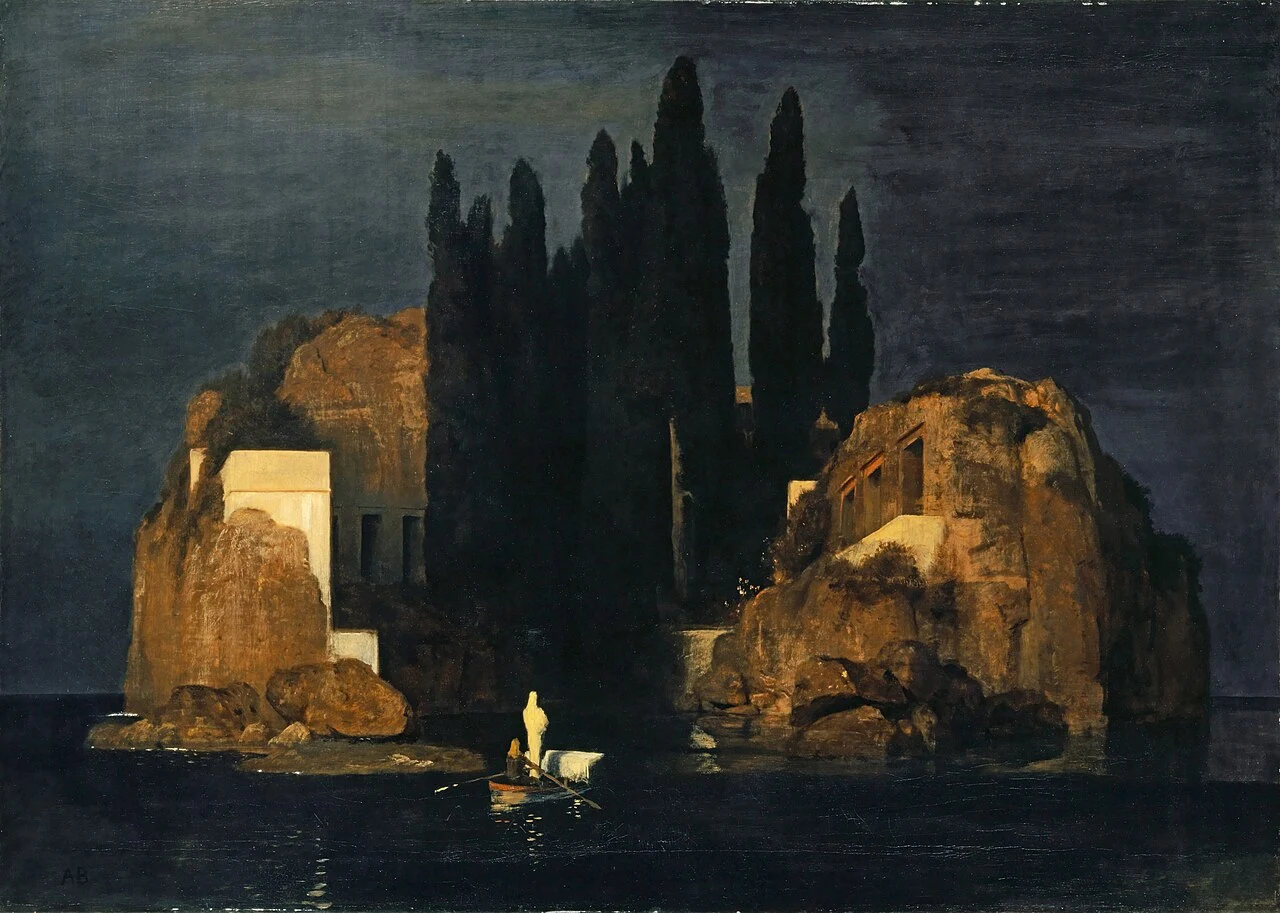
Böcklin’s “The Isle of the Dead”, produced in several versions—the first dating to 1880 at the Kunstmuseum Basel—was initially linked to the passing of his daughter during his residence in Florence from 1874 to 1885, condensing two contrasting visions of the transition from earthly life to eternity.
Arnold Böcklin
Born in Basel in 1827 and deceased in Fiesole in 1901, he was an artist who illustrated in a distinctive manner his perspective on life and death. In this canvas, he places a small yet majestic island rising from dark waters at the center, framed by a sky traversed by gray clouds.
A boat moves toward the island bearing an enigmatic figure draped in white, reminiscent of a funerary statue, seemingly keeping vigil over a small casket on the prow, while the oarsman dips the oars into the water without a sound. The sheer, towering rocks sheltering a dense grove of tall cypresses that mask the entrance invite deep reflection and prayer through a subtle light that vitalizes natural colors and softens grief and mortality.
Vincenzo Cabianca
A breath of humble hope leading to the grace of prayer is found in several canvases by Vincenzo Cabianca, born in Verona in 1827 and deceased in Rome in 1902. In close communion with the Tuscan Macchiaioli, he became an expressive chronicler of daily life, mastering light and shadow through chromatic contrasts.
In the two paintings titled “Matins” (“Mattutino”) and “The Young Nuns” (“Le Monachelle”), one savors the quiet hours devoted to prayer. From the solitary meditation of a priest to the small sisterhood gazing over the sea from the rampart of an isolated convent or chapel, the soul turns toward God’s boundless creation. It is the prayer of the living and the dead, to which these figures dedicate themselves far from worldly clamor, inviting us to cherish this vital Work of mercy.
Luigi Nono
Another keen observer of the reality of his time was Luigi Nono (1850-1918), a distinguished figure of the Venetian school and professor of painting at the Academies of Venice and Bologna.
We owe to him a work that brings us back to a bygone era when people gathered to pray in the humble courtyards and hamlets outside the city: “Evening Prayer” (“La preghiera della sera”).
The scene is set in the small square of Tortesen (Feltre), where a rural community gathers in communal prayer before a small wayside shrine built into a stone wall. Men, women, elders, and children, nearly all kneeling with profound dignity and devotion, face the shrine whose dedication is not revealed, emphasizing the praying collective itself.
The warm hues of the garments, the uneven cobblestones, and the stone cottages, in balance with the lush green foliage backed by a snow-crested mountain in the distance, draw the viewer into this heartfelt prayer for the living and the departed.
Certainly, our prayer cannot match that of Jesus, so deeply suffered in the Garden of Gethsemane and so unceasingly merciful toward the afflicted, yet it remains an indispensable priority in our daily lives and wakeful nights.
Being Witnesses of Mercy – ILLUMINATE
2 February 2026