


 Italy
Italy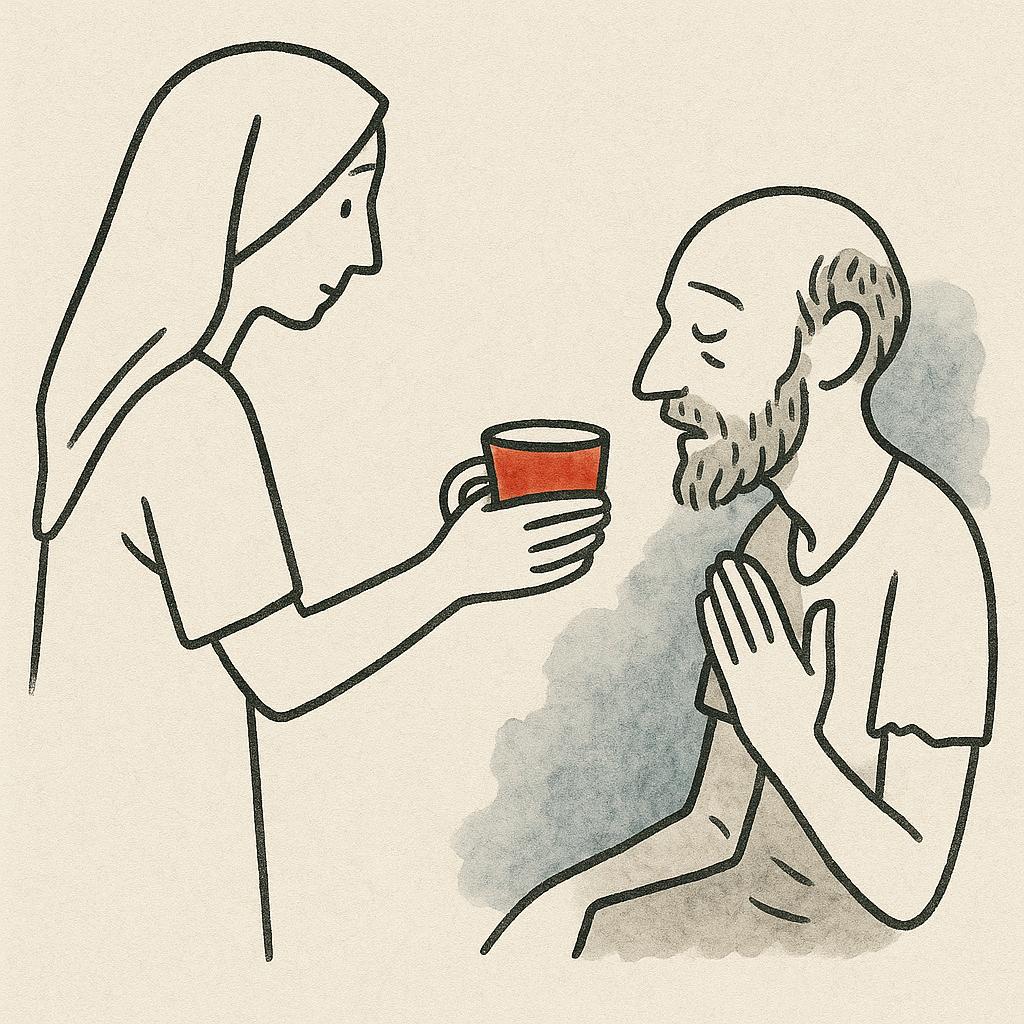
From the website of the National Office for Health Pastoral Care of the CEI, a commentary on the second corporal work of mercy (by Father Tullio Proserpio, Chaplain of the National Cancer Institute of Milan).
This is a well-known expression capable of conveying a concrete invitation to stand in solidarity with those experiencing this need. We are reminded of the theme of water as described throughout the Gospels. We likely know several passages: Jesus meeting the Samaritan woman at the well when, tired from His journey, He sits beside it (Jn 4:6); Jesus hanging on the cross saying: «I thirst» (Jn 19:28); and seeing that Jesus on the cross was already dead, one of the soldiers pierced His side with a spear, and immediately blood and water came out (Jn 19:34).
The encounter at the well and the thirst for relationship
In particular, the episode of the Samaritan woman reveals what a deep need and great thirst there is for true, authentic relationship. In this passage, both Jesus and the Samaritan woman approach the well driven by thirst (in truth Jesus is weary from travel, yet when the Samaritan woman arrives, He asks her: «Give me a drink»).
Jesus dares to show His own need, His inability to act alone; He displays His own poverty. Only those who share the same condition of poverty can genuinely draw close to another. A genuine sharing of poverty can open up space for a true and fruitful relationship, the outcome of which is guaranteed to no one and yet is guarded by the Lord.
This is precisely what happened to the Samaritan woman, to the extent that after meeting Jesus, the evangelist writes that «she left her water jar, went away into the city…» (Jn 4:28). It almost seems to tell us what truly quenched the thirst of both: a genuine and deep encounter—in other words, the relationship itself! A relationship that, precisely because it is authentic, restores both and imparts renewed energy; the future is transformed, and hope is reborn: «Could He be the Messiah?».
Care and shared hope
A recent study conducted at the National Cancer Institute in Milan (“Hope in cancer patients: the centrality of relationships as a crucial aspect”) strongly highlights how relationships are capable of sustaining sick individuals through their journey and fostering genuine hope.
Those who encountered Jesus and entered into relationship with Him departed transformed, showing that meeting Him was capable of healing anyone willing to let themselves be encountered by Him. In some way, we might say that Christ Himself is the “remedy” capable of bringing refreshment, peace, and serenity to the body, and often to the soul.
A relationship is never neutral; it involves us. Perhaps this is one reason why entering into relationships can be daunting: I know how I enter, but I do not know how I will emerge. One cannot know beforehand what will happen, not only to the other person, but deep inside the person who makes themselves available to meet another in their need. The study referenced above reminds us that the more reliable the caregiver becomes in dialogue and encounter, the more hope flourishes.
Christian faith holds relationship at its heart: from person to person; the Christian God is a personal God. Every human being seeks and yearns for such connections because every person is created in the image and likeness of God, bearing that divine imprint whose deepest essence is a loving communion: Father, Son, and Holy Spirit.
The face of God in human closeness
A relationship cannot be possessed; it must be lived. It is an ongoing becoming, a dynamic rather than static reality. The need for connection expresses our truest humanity. And this is exactly what Jesus lived in His human journey: a daily relationship with God the Father, so beautifully recounted in the Gospels.
I believe we are increasingly aware of a profound crisis of humanity today. In this, we can discern a providential purpose: those who profess faith are called to embody this genuine human image, following the example of Jesus who—deeply human in every dimension—captivated all who spoke with Him.
Such a man, fully and completely realized, capable of drawing close to others, feeling with them, suffering alongside them… such a man could only be God. I believe this is the very Face of God we are called to witness to. As individuals within the Church, we bear the responsibility not to betray that Face which still fascinates and attracts, even among those who consider themselves non-believers.
A man who welcomes, does not judge, comforts, weeps, laughs, and shares joys and sorrows with the men and women of His time. Without ever being naive: a man who quenches the parched yearning of every human heart. He is certainly capable of anger—never with the sinner, but against hypocrisy and falsehood, or when rules and regulations are placed ahead of the human person.
Encountering people who face hardship, fear, anxiety, illness, and suffering reveals the immense expectations—at times demands!—placed upon the Church and its members. It is then, with wonder and gratitude, that we recognize the timeless truth of Jesus’ words: «Lift up your eyes and look at the fields, for they are already white for harvest» (Jn 4:35).
We all understand how much hinges upon the quality of the relationships we build with those we meet. We are called to cultivate an adequate preparation: not merely theoretical and conceptual, but primarily and essentially human! Immersed as we are in complexity, we must truly walk together, nurturing an alliance that expresses genuine service to the whole community, aware that «one never hopes alone, but with others and for others».
Image created digitally by spazio + spadoni
Source: National Office for Health Pastoral Care of the CEI – Father Tullio Proserpio
Being Witnesses of Mercy – ILLUMINATE
2 February 2026