



 Italy
Italy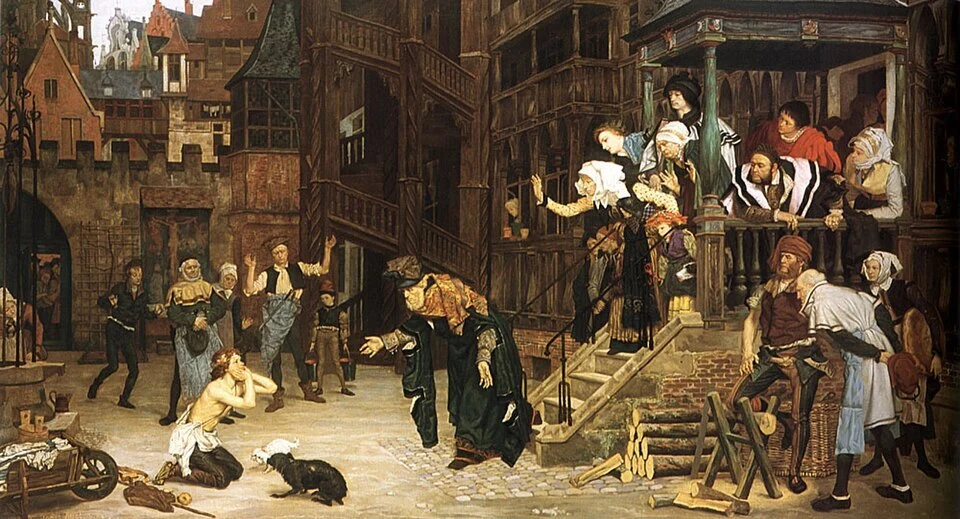
The spiritual work of mercy «forgiving offenses» seen by some painters.
How can one forgive offenses? Who can answer this question? Can Mercy, emerging from sorrow, reach forgiveness? There are those who answered not with words, but with a practical and indelible example.
Some artists have also summarized the suffering endured and forgiveness in images that remain not only masterpieces of art, but above all sources of reflection and teaching.
Bramante’s (1444-1514) «Christ at the Column» should be observed for at least a few minutes to obtain a partial answer to the initial question. The author, born into a poor family near Urbino, was trained in the Montefeltro environment and was soon called to Milan, where he left architectural works of great significance. He does not hold the fame of being a great painter, but this 1490 panel painting at the Brera Gallery is his only firmly attributed panel painting, and its beauty leaves us enchanted. As is well known, the whole life of Christ was lived, above all, for the forgiveness of sins.
Bramante
The iconography of the era, prior to the crucifixion, depicted Jesus bound while the flagellators raged against Him in the place where He was interrogated and tortured. Bramante, on the other hand, eliminates the other figures and presents only Jesus in a half-length portrait, with a face of unique beauty and spirituality, accompanied by a careful analysis of details defining those clear eyes, from which a transparent tear falls—a sign of compassion directed more toward His tormentors than toward His own fate. He places the bruised left eye in shadow, while showing the Teacher’s semi-open mouth in the act of speaking to His striker, a dialogue that undoubtedly invites conversion and forgiveness.
The frontal lighting creates an interplay of colored reflections, ranging from luminous blonde and azure tones to the reddish hue of His hair and beard, highlighting the musculature of the torso of that flawless body, bound by thick ropes to a Renaissance pillar. Between Christ’s head and shoulders, visible through an open window, is a landscape radiating the serenity of creation, while on the windowsill sits a golden pyx recalling the Eucharist.
William Bouguereau
It is not easy to synthesize sorrow and merciful forgiveness through a single image; William Bouguereau (1825-1905) achieved this with the «Pietà» of 1825 (long owned by Mel Gibson). Of English ancestry and Catholic faith, he produced works of outstanding quality, characterized by a masterful pictorial command derived from the anatomical and realistic studies of his time. In this painting, Our Lady lovingly embraces the body of Jesus following the crucifixion.
The gold of the halos, enriched with neoclassical ornamentation behind the black mantle devoid of chiaroscuro and volume, enhances the sorrowful countenance of the Virgin. In shadow rest her large dark eyes, reddened by tears visibly streaming down her face; her lips, sealed by the strength of forgiveness, cannot utter even a complaint. Her silent weeping speaks volumes, appearing to ask the reason for such cruelty, while she presses close to her merciful heart her Son, taken down from the cross, His head reclining upon His Mother’s shoulder.
James Tissot
Closer to our time is the pictorial interpretation of the prodigal son offered by Tissot. Initially an accomplished portrayer of Parisian high society in the nineteenth century, after a mystical crisis he moved to Palestine, where he studied the New Testament for a decade. James Tissot, born in Nantes in 1836, produced hundreds of prints and illustrations depicting episodes from the life of Jesus.
«The Return» invites humanity of every era to see itself reflected, through the stages and missteps of life, in the prodigal son. The painting depicts the embrace between father and son in a harbor evocative of his native Nantes, where a herd of swine is about to be loaded onto a vessel, while on the right side of the boat the older brother looks on impassively, in clear allusion to the parable.
Through an interplay of light and shade, Tissot conveys the heavy burden weighing upon the hearts of both figures: the son, his legs buckling almost abruptly upon seeing his father, and the parent who drops his hat to bend down and embrace him.
The young man’s face almost disappears within the father’s arms, while his hands grasp the father, who in turn caresses his son’s head and seems to restore, through forgiveness, that lost dignity. Everything emotionally engages the viewer, conveying the profound feeling experienced by the protagonists.
The tenderness of this gesture, so powerfully captured by James, together with the admirable examples of Jesus, Mary, and the great saints, can certainly grant us the strength to accomplish this Work of Mercy as well.
Being Witnesses of Mercy – ILLUMINATE
2 February 2026