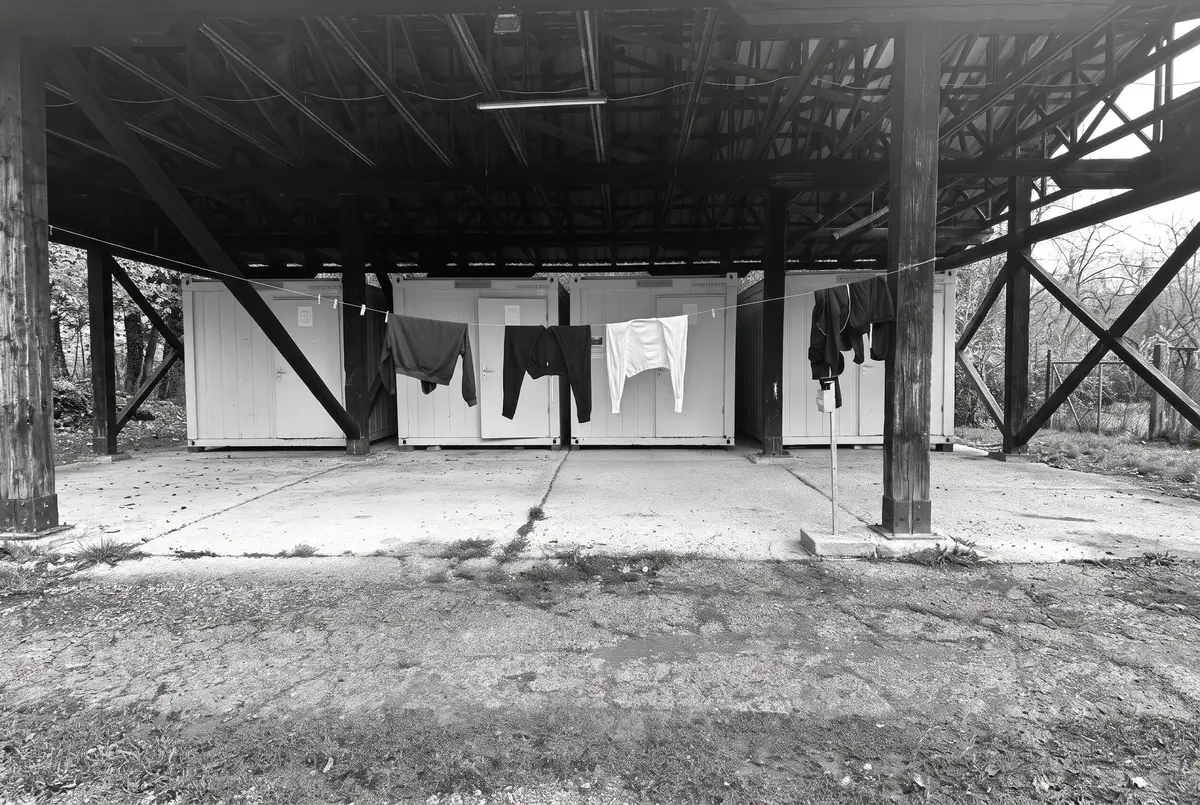
The Obrenovac refugee camp in Serbia, where families fleeing war, persecution and discrimination found shelter.
Over the past two years, Serbia has gone through one of the most significant political phases since the end of the Yugoslav wars.
A period that began with a tragedy and culminated, on October 25, 2026, in an electoral turning point that could profoundly change the face of the country.
It all started on November 1, 2024, when the collapse of the canopy at the Novi Sad railway station resulted in the deaths of 16 people.
The tragedy quickly becomes the symbol of a deeper malaise: students and citizens demand that accountability be established, denounce corruption, and question a political system dominated by Aleksandar Vučić and the Serbian Progressive Party, the SNS.
The protests, born in universities, transform into a national movement. For months, students occupy campuses and organize demonstrations across the country, gathering support that goes far beyond the university world.
The crisis has opened a new political phase, in which demands for institutional renewal have intertwined with the debate over Serbia’s democratic future, its relationship with the European Union, and delicate international balances.
Over the course of 2025, Serbian squares thus become the center of an increasingly widespread protest: thousands of people demand transparency and the independence of institutions.
For nearly two years, Vučić tries to maintain control of the situation, while the student movement gradually shifts from a spontaneous protest to a political force. The snap elections of October 25, 2026, mark the decisive moment; the result surprises in its scope, and Vučić himself concedes defeat.
For me, it is impossible to observe this transformation without thinking back to Obrenovac.
Before getting to know Serbia through its politics, I came to know it through the people who arrived there in search of refuge. For a year, I was part of the White Helmets project promoted by Caritas Italiana, serving in the Obrenovac refugee camp and focusing primarily on the children.
Many of them came from Syria, Iraq, Turkey, and Kurdistan. Together with their families, they had left their countries due to war, persecution, and discrimination; many belonged to religious minorities and were fleeing contexts in which their very identity exposed them to danger.
In that camp, I learned to view international politics from a completely different perspective; wars, religious conflicts, borders, and government decisions were no longer just news to read in the newspapers: they took shape in the stories of the people I met, in the children I spent my days with trying to build a few moments of normalcy.
Obrenovac showed me another Serbia: a country marked by the consequences of wars and migration, which knows well the meaning of flight and uprooting.
Today, I look at the images of the protests and the students’ electoral victory and see a different reality: not people forced to leave their country, but a generation that wants to stay and try to change it. They are distant stories, but both tell of the need for a place to feel part of a community and be able to imagine one’s future.
The children I met in Obrenovac had not chosen to leave. The Serbian students who brought their protest to the polls today have instead chosen to stay.
Perhaps it is in this very difference that one of the most significant images of today’s Serbia emerges: a country that still bears the wounds of the past, but where a new generation seems to want to build the future without being forced to flee.
Photos by Chiara Prontera
Share this article
Words can inspire, sharing can help them reach even farther.


 Italy