



 Italy
Italy
The spiritual work of mercy «to counsel the doubtful» viewed through the paintings of three artists.
How many times have we offered advice—good or not so good—in a superficial way, and how many times have we received useless advice?
Good counsel is born of mercy toward others and stems from a sincere faith that generates wisdom; only in this way does counseling become a work of mercy.
The young man who asked Jesus for advice carried a deep doubt: «Teacher, what good deed must I do to have eternal life?». Jesus listens, answers, and concludes: «If you wish to be perfect, go, sell what you possess and give to the poor, and you will have treasure in heaven; then come, follow me».
The painting by Heinrich Hofmann: «Christ and the rich young ruler»
Heinrich Hofmann (1824–1911), a German painter influenced by early German, Dutch, and Italian Renaissance masters, offers a clear interpretation of this Gospel passage in an 1889 painting, now at the Riverside in New York.
While the two protagonists remain almost in shadow inside a building, on the left opens a small landscape bathed in a dazzling light, a prelude to the «treasure in heaven».
Jesus looks directly into the face of his interlocutor, who turns his gaze away, while pointing to the poor waiting outside the town. The young man’s rich garments, Christ’s modest attire, and the poverty of the destitute contrast sharply through a skillful play of light and shadow, highlighting the gestures of the Master who counsels and invites to perfection.
The painting by Rutilio Manetti: «Saint Catherine of Siena writing»
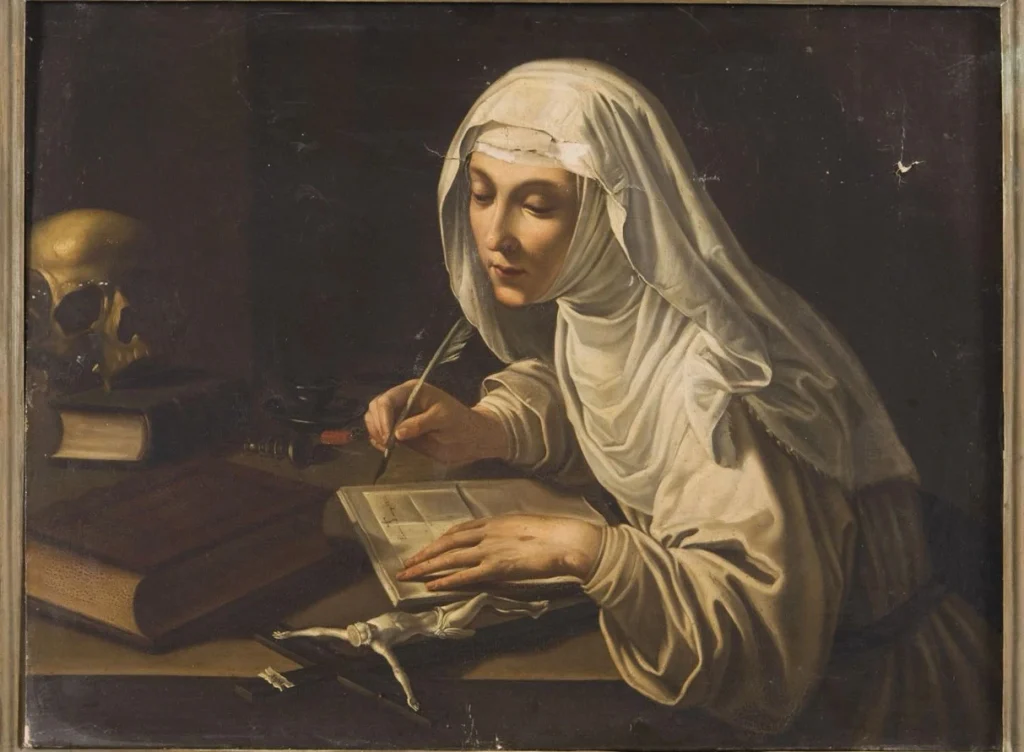
Siena, a splendid Italian city that holds the 1730 Miracle of the Hosts like a treasure chest, gave birth to Saint Catherine on March 23, 1347.
The twenty-third child of a cloth dyer, from early childhood she displayed an unwavering faith and deep love for Jesus, Our Lady, and the Holy Church. It was this devotion that soon led her, with great spiritual vigor, to advise not only humble people, but even the popes of her era on what was right to do.
At sixteen, Catherine experienced a vision of Saint Dominic and took vows as a Dominican tertiary. Soon, the small room of her humble home became a gathering place for scholars, clergy, and educated citizens. Catherine felt a profound desire to offer holy counsel, yet she was illiterate; she prayed to the Lord for the ability to read so she could immerse herself in the Holy Scriptures and recite the Divine Office. This grace was granted immediately and miraculously.
The Sienese master Rutilio Manetti (1571–1639), painter of this 1630 canvas preserved in Figline Valdarno, captured this aspect of her life by depicting her at her writing desk, even though she often dictated her thoughts to keep her mind and heart attentive to God’s will and the counsel she was to impart.
Here, the white veil framing her gently tilted face—attentive to what she is recording—stands out starkly against the dark room, while a subtle supernatural light seems to radiate from her forehead, emphasizing the sweetness of a faint smile.
The painting by Jan Vermeer: «Christ in the house of Martha and Mary»
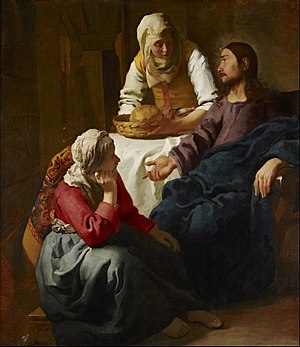
One of the intimate domestic scenes described in the Gospel of Luke recounts Jesus being welcomed into the home of Lazarus’s sisters. Jan Vermeer (1632–1675), the prominent Dutch master of the Baroque period, captures in this 1656 painting, housed at the National Gallery in Edinburgh, the precise moment when Martha, busy with household duties, speaks to Jesus, while Mary sits attentively listening to the Master.
Jesus listens carefully to Martha’s heartfelt words as she looks at him hopefully, yet he points toward her sister, who rests peacefully at his feet, delighting in his words.
Christ’s response is counsel for both sisters, dispelling doubt not only for Martha, but for every Christian, inviting us to choose always the better part in every action and to serve without anxious haste. As Pope Francis reminds us: contemplation gives efficacy to the work undertaken for God; indeed, Mary acts with courageous love by following her Master.
In this painting, the viewer feels drawn into the conversation like a family member, as the figures exhibit natural, familiar gestures.
The interplay of light illuminating key details, the sophisticated harmony of color tones, and the study of volume and transparency make this painting a masterpiece deserving of contemplation as well as admiration.
Saint Catherine meditated and prayed unceasingly, but like Martha and Mary, she performed countless works of mercy among people of every social station.
Among the counsels that history remembers with greatest reverence is her remarkable letter to Pope Urban VI.
In her letter, she writes: «I, Catherine, servant and slave of Jesus Christ, write to you in His most precious Blood, desiring to see you founded upon the true light… This light bears with it the knife of hatred against vice and love of virtue, which knife binds the soul to God and to the care of one’s neighbor. O most Holy and sweet Father, this is the knife I beg you to wield. Now is your time to unsheathe this knife, to hate vice within yourself, within your subjects, and within the ministers of the Holy Church. Within yourself, I say, because in this life no one is without sin; and charity must first begin within oneself, practiced with virtuous love, and then extended to our neighbor… May it please Your Holiness to govern yourself as Divine Goodness demands, each in his own degree».
Saint Catherine employed powerful words in her counsel, urging resolute choices while conveying profound maternal tenderness and love. These remain the enduring lessons of perhaps the most demanding work of mercy, yet with God’s grace, all things are possible.
Image created digitally by spazio + spadoni
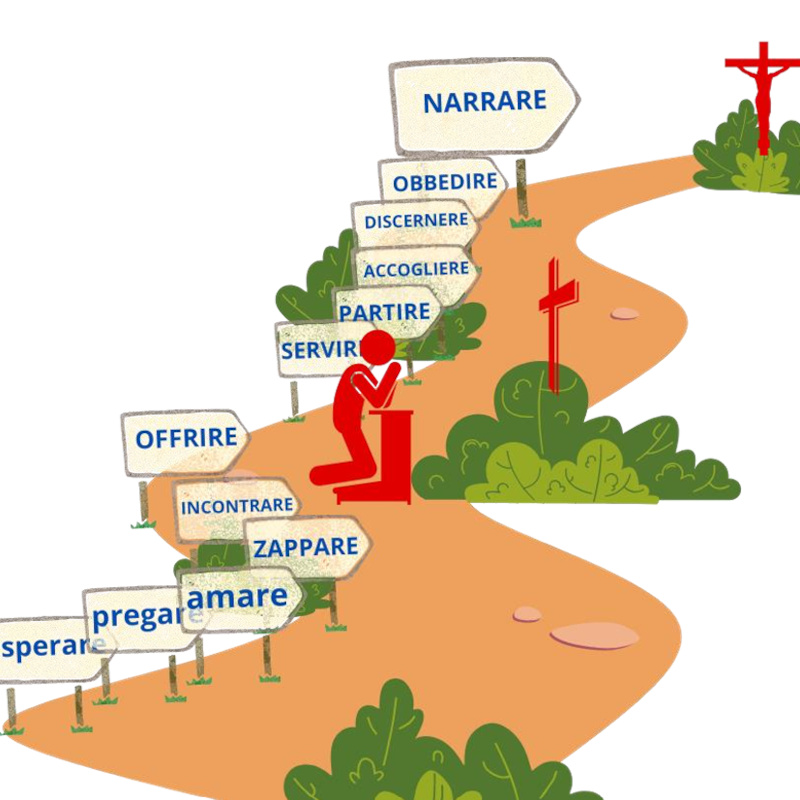
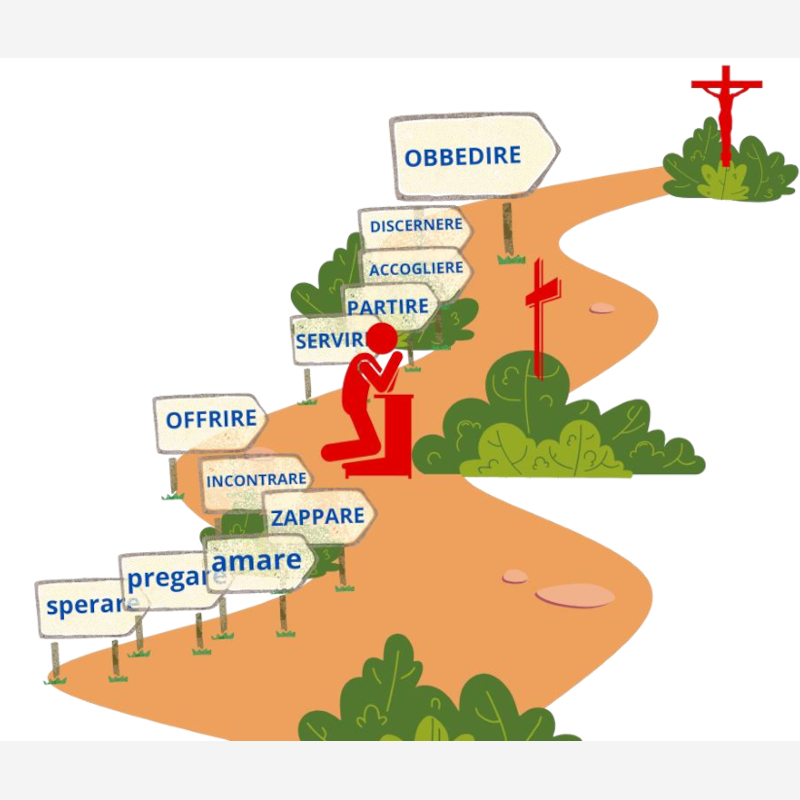
Being Witnesses of Mercy – ILLUMINATE
2 February 2026