 Tanzania
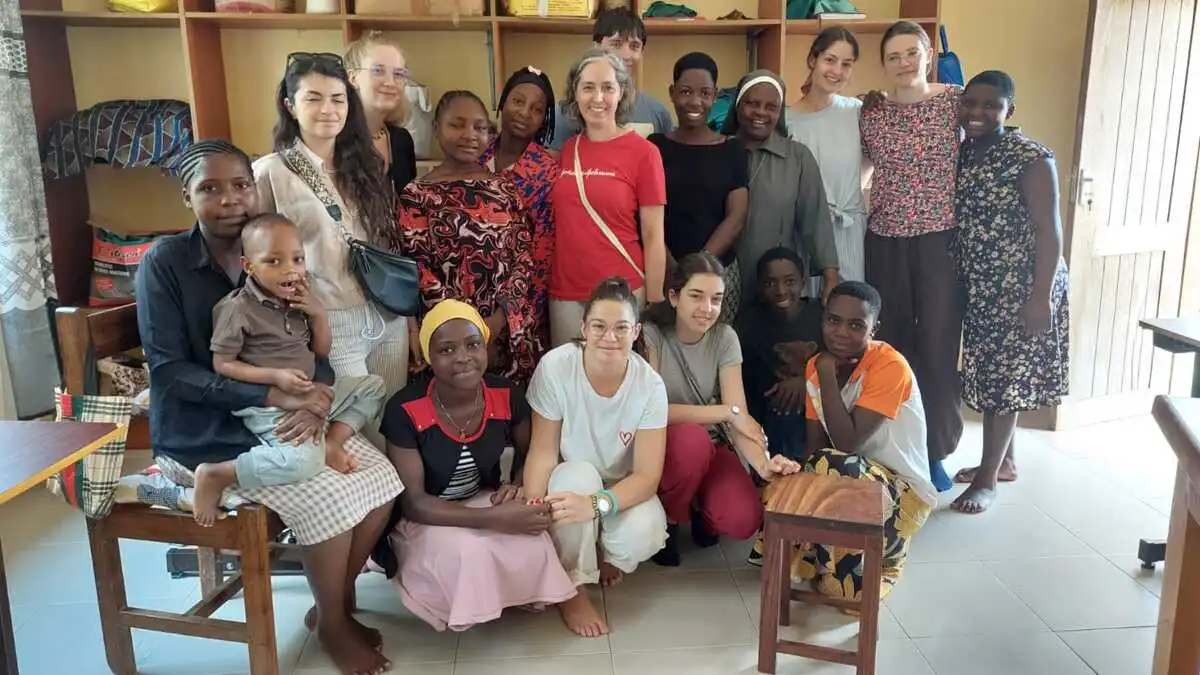
Missionary summer camp with the Cottolengo sisters in Kisarawe
(by Aurora, Chiara, Ester, Francesco, Mirella, Monia, and Serena – Diocese of Lugano)
When going on a trip, you worry about packing your suitcase and choosing what to visit.
Leaving for a missionary experience, especially for the first time, is instead something different: you imagine, you think, you try to arrive at your destination prepared, with the desire to lend a hand and do something for others. Therefore, you don’t just think of yourself, but from the very beginning, you are oriented toward others.
Excitement, anticipation, and an eagerness to roll up one’s sleeves mixed together in the days leading up to the long-awaited moment of departure. Destination: Kisarawe, Tanzania.
Kisarawe is located about 30 km from Dar es Salaam, the capital of Tanzania. It is a small town of about 10,000 inhabitants, spread across a very vast and hilly area.
The sisters of the Cottolengo Congregation, based in Turin, have been present in Kisarawe since 2001. They run a kindergarten attended by 200 children and an elementary school with about 150 students from first through third grade. They also carry out various pastoral activities, including teaching catechesis in schools and visiting the sick.
Since 2004, there have also been two Cottolengo priests who run the parish, located next to the sisters’ house, and carry out pastoral activities with the children and young people of the area.
In Kisarawe, the sisters opened the doors of their home to us with warmth and curiosity. They welcomed us with a welcome cake, singing, and dancing, making us feel right at home from the very first moment. It was the first time they had welcomed so many volunteers together, eight in all (the seven of us from Ticino and a volunteer from Turin), and they were aware that for us, everything would be new and different.
Even though they had advised us to rest on the first day, we quickly immersed ourselves in daily life: the activities in the two schools, with so many cheerful children full of energy; the rough roads; the local dishes; the nighttime noises and Sunday masses, rich with singing and dancing.
From each day, we could tell so many anecdotes that surprised and fascinated us, allowing us to get to know Tanzanian culture better. Sharing our impressions was invaluable: it helped us create an even more close-knit group and allowed us to reflect together on what we were experiencing.
In both the kindergarten and elementary schools, we helped the teachers grade exams and homework, digitize the school register, and even wash the lunch dishes. In fact, all the children stay at school until 3 p.m. and eat lunch together.
In particular, in the elementary school, for the time being, the children eat sitting on mats on the ground while waiting to raise the necessary funds to complete the construction of the school buildings, which also include a kitchen and, above all, a cafeteria.
The school also has a large plot of land adjacent to the school building, where various types of vegetables and legumes are grown, in addition to corn. There are also several fruit trees, with the goal of producing as much as possible for the children’s cafeteria.
In the nuns’ house, there is also a small building used as a tailor shop and sewing school, donated more than 15 years ago by a group of Sardinian volunteers.
The school is run by Zera, a 24-year-old woman who learned to sew from the nuns themselves and then stayed on as a teacher to instruct poor girls who didn’t attend school, allowing them to gain access to training that enables them to have a future and a job. Thanks to their tireless faith in Divine Providence, the nuns are then able to provide a sewing machine for the girls who finish school so they can start their own business.
The girls work very well and create beautiful clothes, bags, and other items. They also make all the uniforms for all the children in the two schools.
We learned a few words in Swahili and had fun surprising the locals. We usually communicated with a bit of English, but mostly through gestures and looks. We thus discovered that it is possible to overcome the language barrier and manage, for example, to cheer on the parish youth soccer team or play with a group of children. All it took was for a ball to appear and a game was guaranteed, with two teams made up of countless players!
One aspect worth highlighting is the initial feeling of embarrassment and discomfort you can experience when arriving in an African country. We are the mzungu (“white people” in Swahili) and, for this very reason, at first we felt watched: people, especially on the street, looked at us, laughed, whispered, and sometimes asked to take a picture with us.
Then, though, skin color fades into the background when you connect with people. With both adults and children, we built a wonderful relationship of friendship and trust. Overall, we met welcoming people, happy to get to know us and eager to show us their culture.
Time management is also completely different compared to what we are used to in Switzerland. Often, the times given to us were not exactly precise. Some of us struggled to get used to this sort of “indefinite punctuality”; others, however, loved it, because it left more time to experience situations without worrying about the clock. All of us, however, appreciated the value of a lifestyle and a way of relating to others without rush and without stress. In any case, we did everything we were told we would do, simply on a different timeline than we had imagined.
Africa gets inside you, it sticks to your heart like the red dust of the roads that stays on your skin and on the soles of your shoes!
It’s so true. They had warned us during training, but maybe we hadn’t given it enough weight: living a missionary experience enriches the volunteers above all.
We returned home with eyes full of happiness, hands eager to turn good intentions into concrete actions, and minds filled with ideas, emotions, and memories.
Do not hesitate: go on a mission! So, SAFARI NJEMA (have a good trip)!
Source: “Insieme in cammino” – CMSI Magazine (Missionary Conference of Italian Switzerland) – Diocese of Lugano, No. 3/September 2026, pp. 10-11-12.