



 Italy
Italy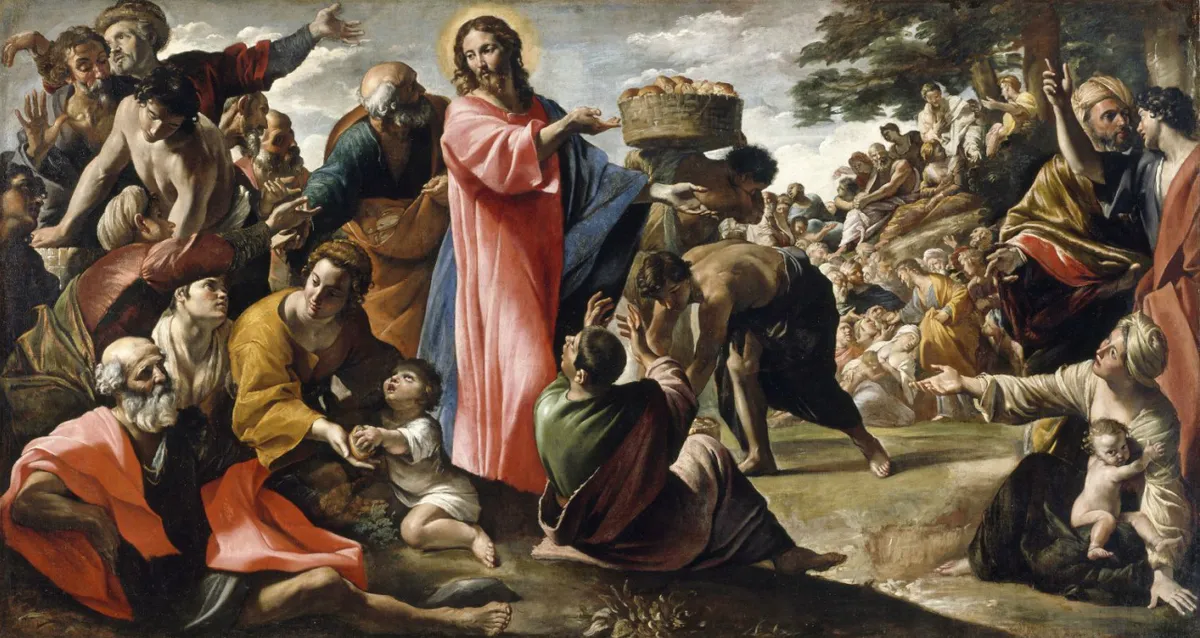
The corporal work of mercy «feeding the hungry» seen through the paintings of various artists
Many artists have endeavored to illustrate the beauty of the works of Mercy, considered individually or as the catalyst for a miracle or an extraordinary event.
Feeding the hungry is a fundamental human need that God chose to answer first. In the Old Testament, various episodes recount God’s merciful care for His people, a reality impossible to overlook.
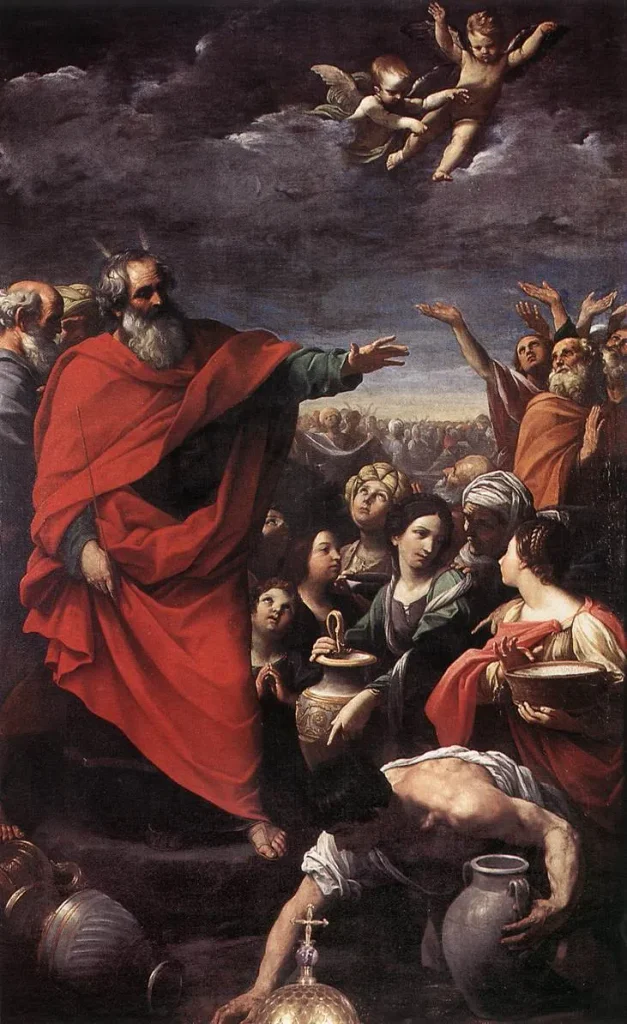
Guido Reni (1572–1642), a Bolognese painter, worked at the Cathedral of Ravenna from 1614 to 1616, depicting the story of Moses and the gathering of the manna: «At twilight you shall eat meat, and in the morning you shall be filled with bread; then you shall know that I am the Lord your God».
In this great painting, Moses, wrapped in his ample red cloak and flanked by Aaron, conveys God’s message and raises his hand to inaugurate the miracle. Below, the Israelites prepare their vessels to gather the manna dropped from a dark cloud by two plump angels, while others lift their hands toward heaven.
The vast crowd fading into the background is rendered in soft, misty shades, like the dawn breaking in the distance to banish the dark night, offering comfort and reassurance to every heart.
Thus, for forty years, they ate meat and bread that tasted like wafers made with honey: a marvelous response that God, in His mercy, granted in the face of His people’s insulting murmurs.
Providing for hungry people was also Jesus’ request to Philip upon seeing the large crowd coming toward Him. Naturally bewildered, the apostle gave a practical reply about the impossibility of such a task, but Andrew dared the unthinkable: «here is a boy who has five loaves and two fish…». There were about five thousand men. Jesus provides!
Giovanni Lanfranco (1582–1647) interpreted this Gospel scene in 1624–25, creating a masterpiece now housed in the National Gallery of Ireland.
In his work, Jesus dominates the canvas, positioned at the center just as recounted in the Gospel. Christ is statuesque yet dynamic, His arms outstretched as He hands out bread personally. The apostles, astonished by the miracle, distribute bread and fish, while the excited and grateful crowd prepares to eat.
While a child in the foreground opens his mouth wide to receive bread from his mother, a young man sitting at Jesus’ feet turns in astonishment toward the Messiah.
Equally poignant is the gesture of this youth who, seemingly speaking to an apostle, points heavenward to declare God’s merciful power.
Color plays a decisive role: the vibrant red of Christ’s mantle immediately commands the viewer’s gaze, drawing it back again and again to the center. Everything magnifies that sacred moment, from the basket overflowing with bread to the chromatic harmony cast by the morning light across trees, meadows, skies, and clouds.
Compassion moved the heart of God, transcending the natural doubts of the apostles, who promptly obeyed the unthinkable and organized the distribution to feed all present.
The tradition of Saint Anthony’s bread stems from a miracle following the construction of the Basilica of Saint Anthony in Padua (1310). Girolamo Tessari frescoed this miracle in 1524 in the audience hall of the basilica in Padua.
The mother of a child who drowned due to her distraction begged Saint Anthony to restore him to life, vowing to give the poor an amount of bread equal to her son’s weight. The miracle took place! From that moment to this day, this answered grace inspires the faithful to show pity and mercy to those in need, offering bread matching the weight of their children to support impoverished mothers.
In 1662, the Flemish master Willem Van Herp (1614–1677) was commissioned to paint this scene—today preserved in the National Gallery in London—showing friars receiving and distributing bread according to the teachings of Saint Anthony.
Each figure is rendered with vivid emotional expression, unique posture, and distinct clothing, brought alive through rich, contrasting colors that heighten the sacred reality experienced by the community.
Here, God acts through the intercession of Saint Anthony, whose devotion moved the hearts of the community to confront human misery.
Without distinction of wealth or poverty, health or sickness, this teaching guides us to grow in charity.
We are not asked to do the impossible; yet these sacred episodes invite us to reflect deeply on world hunger, the sin of food waste, and the duty to act with concrete mercy toward those who starve today.
Cover image: Wikipedia

Being Witnesses of Mercy – ILLUMINATE
2 February 2026