


 Italy
Italy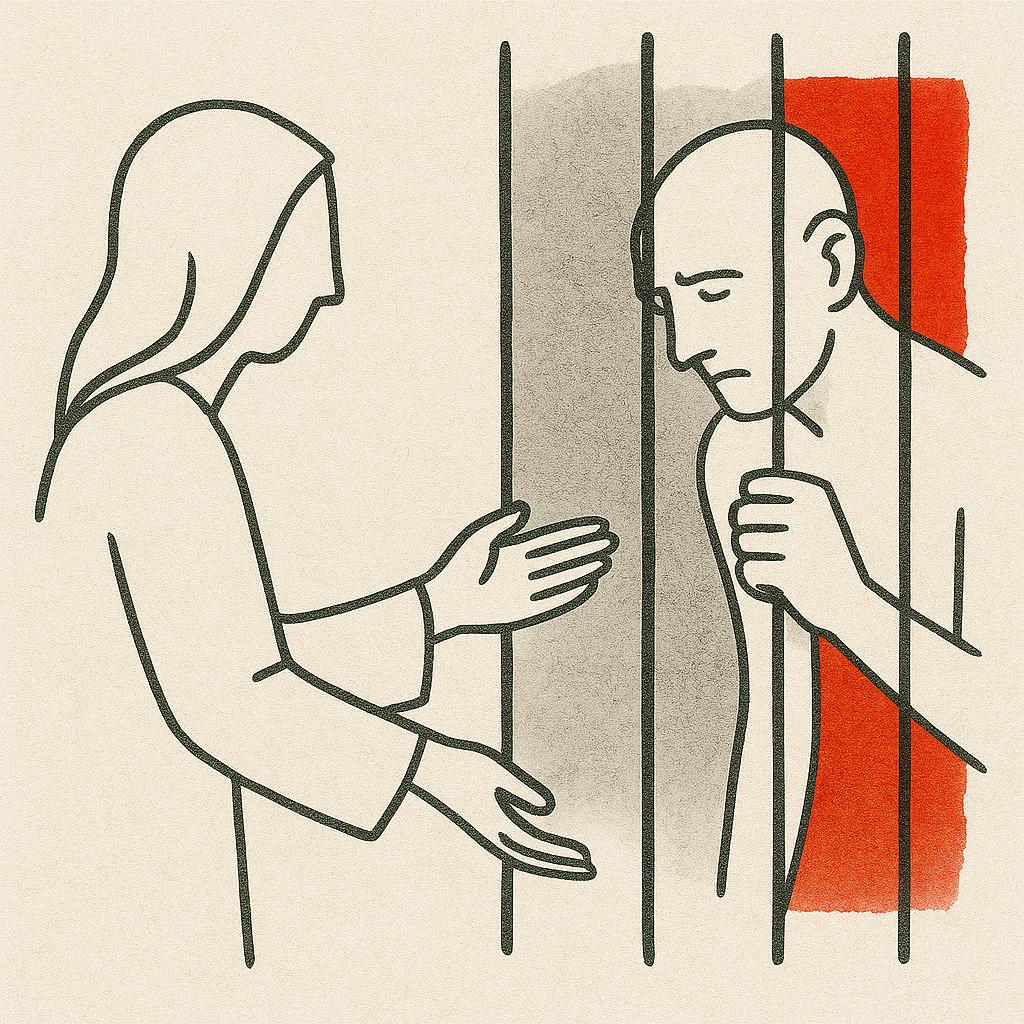
From the website of the National Office for Pastoral Health Care of the CEI, a commentary on the sixth corporal Work of Mercy
(Dr. Marco Lora – CEI, National Office for Pastoral Health Care; Guest Lecturer at the Pontifical Institute Teresianum)
The reality of prison and the denial of freedom
A door shut behind you. This is the image that, more than any other, allows us to grasp the reality of prison. Prison is a closed door that binds freedom. Imprisonment is one of the hallmarks, despite its harshness, of civilization: no longer the law of retaliation, no longer the death penalty, but it is, and remains, a denial of freedom.
Certainly – in Italy – we have witnessed a profound transformation over the last century in the structure of detention and the laws leading to such penalties, and just as certainly the stigma remains upon those who have been convicted.
Yet prison is made of insurmountable walls. Only thought can refuse to remain confined there, flying elsewhere in search of friendly voices, perhaps in search of forgiveness.
Health behind bars: loneliness and personal care
From a healthcare perspective – as noted in the 2013 Opinion of the National Bioethics Committee – many Italian prisons are an overcrowded existential loneliness, a melting pot with a high concentration of viruses and diseases (including HIV, Hepatitis C, and Tuberculosis); diabetes and hypertension are triggered by the absence of minimal physical activity; detention inevitably generates elevated levels of stress and anxiety, while simultaneously annihilating life plans, or at the very least forcing their complete redefinition.
Prison is experienced very differently by male and female inmates. Moreover, within prison, different peoples, races, and ethnicities converge and intermingle, at times in conflict with each other, alongside concentrated issues of drug addiction.
The gospel criterion and gratuitous encounter
The Gospel of Jesus, his definitive word, anticipates and sets forth an unmistakable criterion for interpreting all these diverse situations: «I was in prison and you visited me» (Mt 25:36).
In the first place, the Work of Mercy of visiting an inmate represents a stage in a specific interior journey: the decision to respond to God’s fatherhood, which draws me close to every «least brother». Just as an older brother cares for the younger without expecting any reward, at times even grumbling at the little one’s inadequacy or shortcomings, so in faith one acts with gratuitous love.
A prison visit, particularly when it involves professional medical competence or the ability to offer qualified responses that foster human dignity, reflects a precise inner path: dedicating time, talents, and professional skills out of love.
Direct personal human contact cannot be replaced, not even by advanced telemedicine. While telemedicine is indeed a tool that – given the constraints imposed in prison where security often takes precedence over the right to healthcare – can significantly enhance diagnosis and disease monitoring, personal relationship remains irreplaceable.
Secondly, the question «When did we come to visit you?» (Mt 25:39) prevents us from falling into the trap of an action that reduces itself merely to philanthropy or secular humanism. What matters is indeed the action, the service, the diaconia exercised by the righteous, but there is an ultimate stage: the judgment that unveils Christ, who was already present and whom the heart had yet to recognize.
«God bless you» is a greeting in America; «God bless you» must be the greeting whenever visiting a prisoner.
Witnesses of the Church: from John XXIII to Pope Francis
This spiritual reality, far deeper than fleeting emotion, shines through two historical moments of the contemporary Church.
Saint John XXIII, following his first Christmas as Pope, visited Rome’s Regina Coeli prison. «I put my eyes into your eyes», he said to the prisoners, sending a holy card to those in maximum security whom he could not meet face to face. That saint sought encounter, chose personal proximity, and unlocked the gates of prison after almost a century in which a Pope, confined to the Vatican, had never set foot in a penitentiary.
The second image, more recent, is Saint John Paul II’s 1983 encounter with his attacker. This holy Pope asked that a door be opened so he could enter the bare cell of the man who had shot him.
The Catholic Church has also honored an inspiring figure who entered prisons to bring the extraordinary gratuitousness of the Gospel: the Venerable Giulia Colbert, wife of Carlo Tancredi Falletti, Marquis of Barolo. This married couple made the charity and mercy of God their true identity. Serving the needy together, she worked tirelessly to bring material and moral elevation within prison walls, particularly for female inmates and later for former prisoners, establishing and funding dedicated religious institutions.
Visiting prisoners has remained an indispensable priority for Pope Francis. From the Casal del Marmo juvenile detention center to his journey to Philadelphia in the United States, he has consistently chosen to step inside prisons as a «pastor, but above all a brother». We can witness the Pope drawing close to and embracing inmates.
For Pope Francis, following the saints who preceded him, these physical prison gates, which no one inside can unlock, have become the emblem of the Jubilee of Mercy.
A door that swings open to Christ
In the «Letter for the Year of Mercy», he invited inmates to make their cell doors an instrument of prayer: «May the gesture of directing their thoughts and prayers to the Father each time they cross the threshold of their cell signify for them their passage through the Holy Door».
Visiting the prisoner fosters encounter, attentive listening, the alleviation of loneliness and suffering, physical healing, and the renewal of hope. For both visitor and visited, meeting within prison offers an answer to life’s ultimate search for meaning. That door thus opens, thrown wide to Christ.
(Text from November 2016)
Image created digitally by spazio + spadoni

Being Witnesses of Mercy – ILLUMINATE
2 February 2026