


 Italy
Italy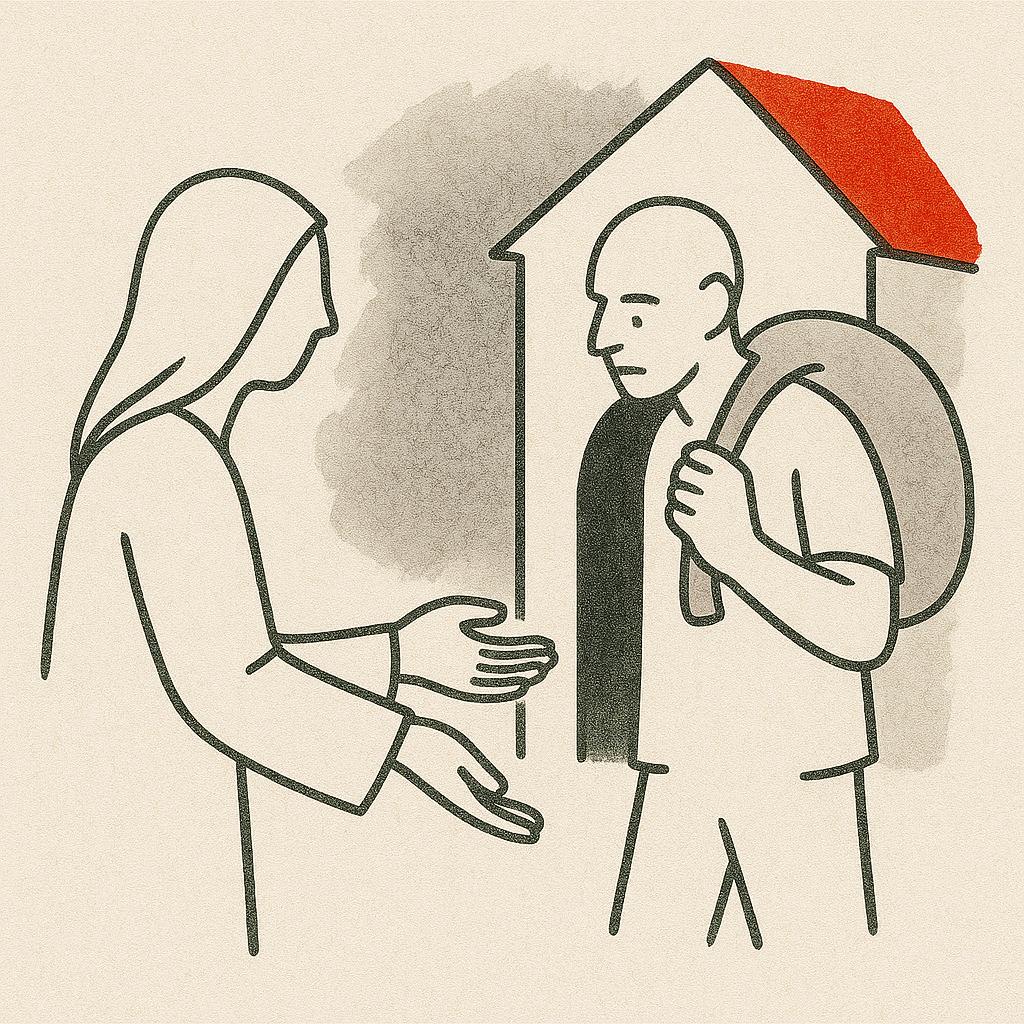
From the website of the National Office for Health Pastoral Care of the CEI, the commentary on the fourth corporal Work of Mercy (by Francesca Di Maolo, President of the Istituto Serafico of Assisi).
[…] Pope Francis invites us to reflect and rediscover the corporal and spiritual Works of Mercy.
This is a way to awaken our conscience. The Works of Mercy are concrete actions in response to concrete needs; they are gestures of love and kindness that transform the lives of those who suffer, delivering them from the evil of indifference.
The commandment Jesus left us: «Love one another as I have loved you» (Jn 13:34) calls us to overcome our selfishness, to recognize the needs of others as our own, to fill their loneliness with love, to share the road with them, and to seek together to give meaning to our journey.
«Let us not love with words or speech but with actions and in truth» (1 Jn 3:18): this is the explicit exhortation in the New Testament.
Welcoming the stranger, alongside the other Works of Mercy, does not represent merely an attitude of the Christian community, but constitutes a fundamental dimension of charity, testifying to and manifesting in action the deepest root of being Christian. “Welcoming” is not merely a moral duty of the Christian, but reveals their very ontological reality.
Already in the Old Testament, hospitality is regarded as sacred: «you were foreigners in Egypt» (Ex 22:20; 23:9). In Abraham hosting the three pilgrims (Gen 18), God visits mankind. «When a foreigner resides among you in your land, do not mistreat them. The foreigner residing among you must be treated as your native-born. Love them as yourself» (Lev 19:34).
We must never forget that the first pilgrim to welcome is Jesus, who comes toward us desiring to enter into dialogue with us.
In the Gospels, Jesus is constantly on the move, and many episodes of welcoming are narrated. Jesus was a pilgrim along the roads of Palestine, assisted by women and hosted by many: «The Son of Man has no place to lay his head» (Mt 8:20); «Zacchaeus, come down immediately. I must stay at your house today» (Lk 19:1-10). He is a guest in Bethany, in the house of Simon the leper (Mt 26:6-13); in the home of Martha and Mary (Lk 10:38; Jn 12:1-2). He himself, as a child, was an exile in Egypt (Mt 2:13-23). «I was a stranger and you welcomed me», a foreigner and you took me in, Jesus states clearly (Mt 25:35, 38-43).
Following the example of Christ, Saint Paul proclaims: «Accept one another, then, just as Christ accepted you, in order to bring praise to God» (Rom 15:7), committing to share the same sentiments, bearing one another’s burdens and «keeping the unity of the Spirit through the bond of peace» (Eph 4:3). Saint Peter tells us: «Offer hospitality to one another without grumbling. Each of you should use whatever gift you have received to serve others, as faithful stewards of God’s grace in its various forms» (1 Pet 4:9-10).
Welcoming the stranger finds formal expression in the Rule of Saint Benedict (ch. 53), when he exhorts the monk to hospitality because «hospes est alter Christus», namely the living and historical image of Christ. The other is part of me; therefore, I welcome him to give concrete expression to the commandment of love: «Love your neighbor as yourself» (Mt 22:39), following Jesus who declared: «Anyone who welcomes you welcomes me» (cf. Mt 10:40; cf. also Mt 18:5; 25:31 et seq.).
Welcoming implies first and foremost openness and dedication toward others, as well as the ability to listen and create space for them within our hearts. A space where one feels accepted as they are. But welcoming also requires knowing how to be a neighbor, caring for one another. To welcome means becoming «a succoring presence».
Jesus illustrates proximity through the parable of the Good Samaritan who passed by the unfortunate traveler, «looked at him», «had compassion on him», «went to him» (…) «and took care of him».
Who is the neighbor to be welcomed and helped?
Without delving into the complex anthropological, religious, and prescriptive-ethical interpretations of the parable, the neighbor can be identified as the brother, the foreigner, the enemy: it is the other.
To explain how the Samaritan drew near to the wounded man, Jesus uses a term expressing the inner transformation needed to practice proximity. Jesus notes that the Samaritan «had compassion on him» (Lk 10:33). The Greek verb “splanchnizomai”, found in the parable, means “feeling something deep within one’s entrails”. Hence the meaning “to feel deep compassion”, “to be moved to mercy”.
In the Gospel, this verb appears 12 times to describe Christ’s attitude when relating to people in suffering and hardship. Faced with suffering, Jesus responds emotionally with his entire being. It is mercy that creates closeness and proximity.
The rejection of the immigrant, the stranger, and the neighbor represents a denial of our Christian identity and of the fundamental reality of human fraternity. The growing trend toward “refusing to welcome” and “mistrusting” undermines the deepest foundations of humanism.
The practice of mercy in welcoming the stranger is today more than ever a source of healing: for the person who practices it, who can heal the wounds of individualism by rediscovering the beauty of the gift of relationship, and for the stranger, wounded by suspicion, denial of rights, and the inability to live a full life.
All the Works of Mercy are invaluable instruments for educating the community according to a pedagogy of concrete deeds. To heal our distrust and inability to live out our condition as human beings and Christians, we need to recover our sensitivity, our ability to be moved by the suffering and wounds afflicting our brothers and sisters.
The time has come to rediscover our full humanity, not to remain indifferent to the pain of others, and to reclaim the beauty and joy of closeness and tenderness. We must decisively embrace the path of hospitality, breaking down every cultural barrier, overcoming ethnic and religious prejudices, and demolishing the walls and borders erected to isolate ourselves from our neighbor.
This Holy Year urges us to follow the path of healing: making our common home habitable for everyone. On the journey of hospitality, every human being and every believer must return to the chair of the least (Mt 5:1-12), addressing their urgent, inescapable needs, lest that very chair, if neglected, turn into a seat of judgment (Mt 25:31-46), while building bridges between the Word and the love lived out in daily life.
Image created digitally by spazio + spadoni
Source: National Office for Health Pastoral Care of the CEI – Francesca Di Maolo (November 2016)

Being Witnesses of Mercy – ILLUMINATE
2 February 2026