

 Italy

“The world is too small for what I desire to do.” It is a phrase that speaks volumes about her way of looking at the world. Mother Cabrini saw in emigrants not simply people to be assisted, but individuals with a story, a dignity, and a hope to accompany. It is a message that we still feel to be profoundly relevant today.
A special bond between Chicago and Sant’Angelo Lodigiano
There is also a special connection between Saint Frances Cabrini and Pope Leo XIV that we came to know directly from the Superior General and her sisters, and which I find truly evocative. Mother Cabrini died in Chicago, in the hospital she had founded. And right there, many years later, Robert Francis Prevost, now Pope Leo XIV, was born. It is a bond that seems almost to transcend time. And the Pope himself has shown his closeness to Mother Cabrini in a concrete way: he visited her birthplace in Sant’Angelo Lodigiano and gathered in prayer before the Saint’s heart. I like to think of this thread linking a woman who dedicated her life to emigrants and a Pope born in the very city where she concluded her earthly life.
A mission from God: irony and community
And, since we are talking about Chicago, allow me a small aside, which might bring a smile to some. Chicago is also the city of the Blues Brothers. And here is a detail that I particularly like: the critic Vecchi, writing in L’Osservatore Romano, dedicated an article to the film that concluded like this: “A mission from God. Which in the end will succeed. Handing over to the history of cinema and music a memorable film. According to the facts, Catholic.” I like this small aside because, behind the irony and the music of the Blues Brothers, there is also a story of community, redemption, and people setting out on a journey for a mission. And perhaps it is not so strange that all of this leads us back once again to Chicago, to the city of Saint Frances Cabrini and her extraordinary work alongside emigrants.
On-the-ground experience with Caritas
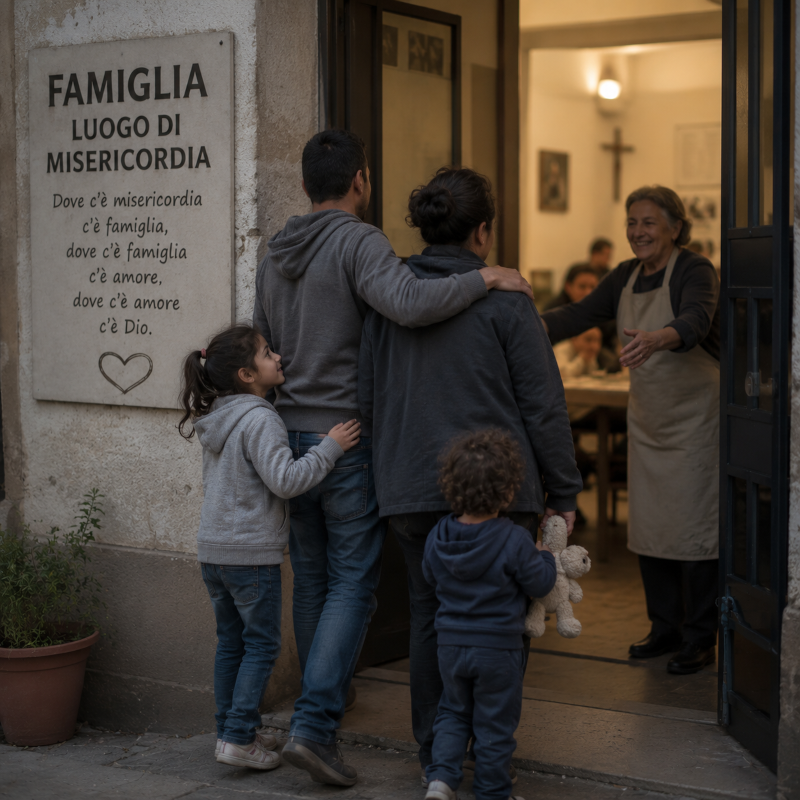
But let us return to our experience. As a Caritas worker, over the years I have repeatedly participated in interventions during landings on our shores. These are experiences that leave a mark. Facing men, women, and children worn out by the journey, you realize that the primary need is not merely material. It is feeling welcomed, looked upon with respect, and recognized in one’s dignity. Sometimes a blanket, a glass of water, or a kind word is enough to restore a little trust. But welcoming does not end with the emergency.
From emergency to autonomy and participation
In our diocese, parishes are the first point of contact. They are the places where needs are identified, food parcels and basic necessities are distributed, but above all, where that initial relationship of trust is built, allowing a person not to feel alone.
Then, when more complex needs arise, a more structured network comes into play. For about two and a half years, the Territorial Area’s Help Desk for foreign citizens has been active, managed by the IPAD Cooperative and APS Form.Ami.
The Desk accompanies people in orientation, access to services, administrative procedures, and paths toward social and job inclusion. It is a path that starts from basic needs but strives toward autonomy.
And there is an aspect that I consider particularly meaningful: through this accompaniment work, together with the Municipality and local organizations, initiatives for participation and self-organization have also been born. I am thinking of the Association of Malians of Puglia and the Denè Farafiná – African Help Association, which came into being thanks to the support of the Desk and collaboration with the Mayor. This is an important step: it means that foreign people are not merely recipients of aid, but can become active protagonists in the community, sharing skills, experiences, and capabilities. This, I believe, is the deepest meaning of our work: not doing things in place of people, but accompanying them so they can build their own path. And here, nobody works alone. Parishes, Caritas, local administrative districts, institutions, associations, and volunteers are all part of the same network.
A window on the Mediterranean to hope together
I would like to conclude by returning to Saint Frances Cabrini’s words: “The world is too small for what I desire to do.” It is an invitation to widen our gaze and our hearts. We live in a land that Father Tonino Bello defined as a “window on the Mediterranean.” A window is not meant for closing oneself in, but for opening up: to look beyond, meet the other, and allow oneself to be questioned by the stories of those reaching our shores. And I would like to entrust the conclusion to the words of Pope Leo XIV, who reminds us how important it is that there grow “in the hearts of most the desire to hope for a future of dignity and peace for all human beings.” I believe this is precisely the meaning of our work: helping those who arrive in our land not to lose hope and, at the same time, helping our community discover that encountering the other can make us all more human. Because a welcoming community does not only change the lives of those who arrive. It changes itself as well.
Photo by Massimo Buccarello