


 Italy

From the website of the National Office for Pastoral Healthcare of the CEI, the commentary on the fourth spiritual Work of mercy
Father Danilo Priori* (National Vice Assistant UNITALSI 2016)
The beatitude and the meaning of consolation
In the Sermon on the Mount recounted by the evangelist Matthew, we can identify the beatitude through which to reinterpret consoling the afflicted as a spiritual Work of mercy: «blessed are those who mourn, for they shall be comforted» (Mt 5:4). But who, then, are the afflicted? And what is consolation? And why should mourning be a beatitude? Furthermore: why is consoling the afflicted a spiritual Work of mercy?
To answer these questions, and thus reconstruct and actualize the profound meaning of the Gospel, we need to broaden our horizons by drawing upon other passages of Scripture. First of all, it must be said that a beatitude is a kind of wishing declaration of happiness recognized for those who find themselves in certain situations and conditions, along with the underlying reason for that happiness; in other words—applying these initial considerations to our Work of mercy—being afflicted is a state of happiness because one is in a condition to be comforted. Yet it remains difficult to believe, for us who are accustomed to fleeing tribulations, that finding oneself in affliction can be a cause for exultation because we are comforted by the Lord, the source of all consolation.
The model of Christ and the consolation of God
Another biblical passage comes to our aid: «Blessed be the God and Father of our Lord Jesus Christ, the Father of mercies and God of all comfort, who comforts us in all our affliction, so that we may be able to comfort those who are in any affliction, with the comfort with which we ourselves are comforted by God. For as the sufferings of Christ abound in us, so also our consolation abounds through Christ. If we are afflicted, it is for your comfort and salvation; if we are comforted, it is for your comfort, which produces in you patient endurance of the same sufferings that we suffer. And our hope for you is firm, convinced that as you share in the sufferings, so also you share in the consolation» (2 Cor 1:3-7).
We begin then to understand that, strictly from the believer’s perspective, we are called to comfort the afflicted because we follow Jesus as the perfect model: he is the one who comforted us first by showing the merciful face of the Father, and in the same way asks us to console those in whom we can perceive his suffering face. It is clear that for an action to be perceived as consolation, it must possess specific qualities; otherwise, we risk treading Job’s path: to his friends who presumed to explain the reason for his suffering, he replied straightforwardly that God’s ways are incomprehensible, for some men spend their lives without distress while others never taste good; his dismay before inexplicable suffering led him even to say: «Why then do you comfort me with empty notions, while deceit remains in your answers?» (Job 21:34).
Harsh words from Job, yet so close to our own laments whenever we fail to find an explanation for our afflictions. The essence perhaps lies in the fact that the consolation announced by the Gospel transcends mere explanations and takes root entirely in faith: it takes profound faith to welcome affliction into our lives and accept it in the awareness of being comforted by the good God.
The silent presence beside those who suffer
It is often said that true consolation is that in which you manage to abide in the other’s affliction while respecting—in some measure—the solitude in which they dwell because of suffering; meaning that no human being can eradicate affliction, yet every person can draw near and, through closeness, allow the Lord’s consolation to be felt. After all, the Gospel can be read as a grand pilgrimage through which Jesus comforts the afflicted creature—sometimes healing, at other times teaching, at others instilling hope that every affliction will be turned into joy (cf. Jn 16:20); and to the Church he entrusted the mandate to continue this work of consolation until the day when the Lord «will wipe away every tear from their eyes; there will be no more death, nor mourning, nor crying, nor pain, for the former things have passed away» (Rev 21:4).
In the meantime, it is up to us to remain close to our afflicted brother, aware that not everyone manages to find an explanation for their suffering, and when that occurs, we can regard it as a true grace. It is, ultimately, a matter of standing beside the afflicted person, regardless of the cause of affliction, with the willingness to simply be present without presuming to know the precise words and gestures that will bring relief, freeing ourselves from those clichés of consolation that demean authentic Christian comfort.
Perhaps the most beautiful and perfect image of consolation is the one described by the evangelist John, who recounts the silent presence of the Mother at the foot of Jesus’ cross (cf. Jn 19:25); their gazes had no need for words, their hands could touch only in the shared agony of their hearts, like two afflicted souls sharing the same destiny and comforting one another in the depth of their breaths.
(Text from November 2016)
*Father Danilo Priori passed away in 2023 at the age of 53 due to a rare genetic disease.
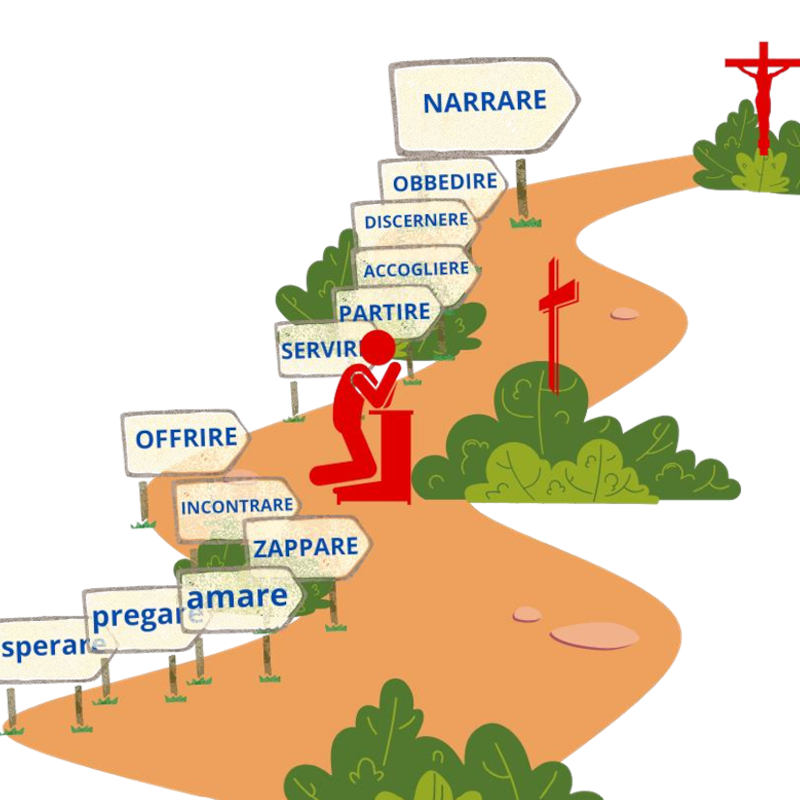
Image created digitally by spazio + spadoni
Source: National Office for Pastoral Healthcare of the CEI


Being Witnesses of Mercy – ILLUMINATE
2 February 2026