



 Italy
Italy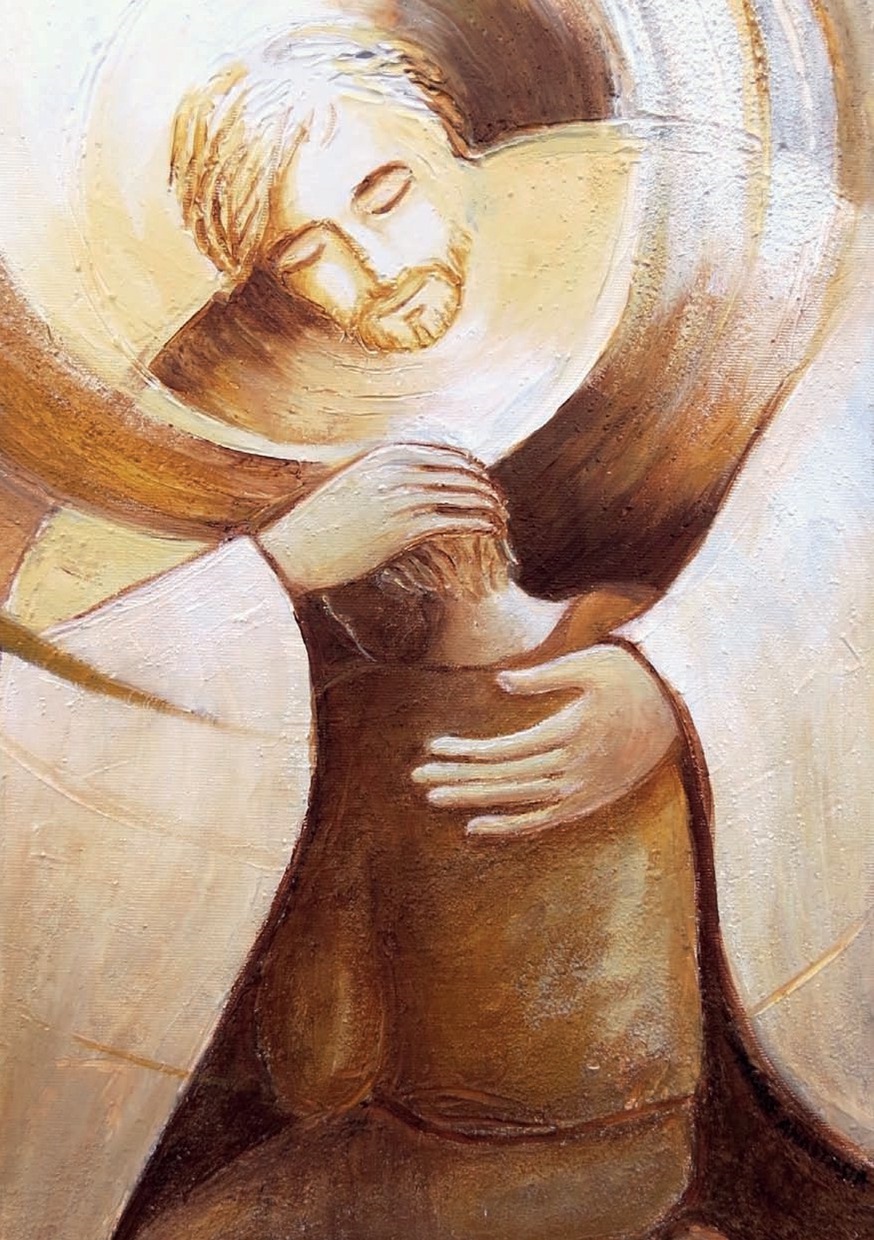
It is the only Work of Mercy that does not look at people. Instead, it dwells on one thing: the offense. It is broader. It has no boundaries. It is not limited to a single category, because it covers and touches the hearts of all of us. Day by day. Because forgiveness is in fact decisive and discriminating in building society and the family. Because it starts from the heart and speaks to the heart!
Forgiving is therefore the pinnacle for the believer. It is the human action that most of all corresponds to the divine. But the social value of forgiving offenses is also immense.
Where there is forgiveness, indeed, there is a garden, growth, and the fragrance of blessing. Conversely, where there is no forgiveness, the desert advances and everything closes in, coming to a standstill.
And just as forgiveness is the gesture that brings us closest to God the Father, so forgiveness is the truest sign of our human dignity. In forgiveness, heaven and earth, God and Man, humility and greatness are wonderfully intertwined. (Giancarlo Bregantini)
At the most dramatic moment of his earthly existence, Jesus breaks the chains bound by his assailants, tears down the wall erected by his executioners, and profoundly shakes our hearts with the forgiveness he extends to his torturers, piercing the darkness of that terrible moment with a flash of light when he asks the Father to forgive them: “Father, forgive them, for they know not what they do” (Claudio Barbieri).
Among the unprecedented Gospel teachings, the most astonishing is perhaps this: “If your brother sins against you seven times a day, and seven times a day turns back to you saying, ‘I repent,’ you must forgive him” (Lk 17:4).
This is already a difficult undertaking; but at least here an offender is apologizing. In reality, Christ’s overall teaching is broader and unconditional: “Whenever you stand praying, forgive, if you have anything against anyone, so that your Father also who is in heaven may forgive you your trespasses” (Mk 11:25). In this school the apostles teach: “Do not repay anyone evil for evil” (Rom 12:17); on the contrary, “bless those who persecute you” (Rom 12:14).
It is a language familiar to our ears that no longer shocks us. But its practical implementation is far removed from human customs, which are dominated by harbored resentments and grudges.
One of the strongest causes of social unrest stems precisely from the rampant spread of hatred and vengeance, which trigger an endless chain of reprisals and therefore suffering.
Hence the importance of the fifth mercy that the Church brings to the world: the encouragement to cultivate and promote in everyone a “culture of forgiveness” (Cardinal Giacomo Biffi).
The Lord’s Prayer places us squarely under a magnifying glass, confronting us with our responsibilities and inviting us to examine our stance with deep awareness. A stance that, on the one hand, must actively give substance to forgiveness, and on the other, must rely on the Lord’s mercy in asking to be forgiven.
“… and forgive us our debts, as we also have forgiven our debtors…”
We immediately see that a fundamental truth is present in the process of forgiveness: whoever is aware of God’s forgiveness knows how to forgive. Because by looking with compassion and mercy upon the one who has offended us, we also recognize that we are offenders, and therefore in need of asking for God’s forgiveness with humility and trust (Claudio Barbieri).
The courage and strength to forgive constitute the soul of Christian life, but also the path to building deep and lasting human relationships. Jesus continuously invites us to forgive offenses.
To be sure, forgiving is difficult; in the world it sometimes appears to be a weak reaction, almost contrary to our spontaneous instinct. Revenge, on the other hand, appears as the reaction of a strong person.
Yet revenge resolves nothing; on the contrary, it makes the heart increasingly bitter, closes it in upon itself, and acts as a poison that can have devastating effects (Hermann Geissler F.S.O.).
Forgiveness “from the heart” helps us avoid keeping a ledger against the other, which is constantly reopened whenever another small incident occurs.
In this sense, the following invitation from Mother Julia is profoundly meaningful:
“Let today be for you the day you put an end to the past. Let today be the day you set fire to all account books of debts, to the ledgers and records you still hold in your heart: burn everything in the fire of God’s merciful love. Truly, light a great fire: the greater the debt, the brighter the light will shine forth. Behave differently toward one another, as though you were seeing each other for the first time; yes, I repeat to you, forget everything you have stored in your mind. Begin anew with the help of grace and faith” (January 25, 1981 – The Venerable Mother Julia, Mexican, 1881–1974 – Missionary Daughters of the Most Pure Virgin Mary).
Yet how much progress humanity has made on this demanding, rigorous, yet so liberating journey on the road of forgiveness! And with every step, at every stage, humanity has grown.
It has freed itself from the tragedy of revenge, from the philosophical justification of war (even if it still lingers in our hearts as a tragic “madness!”), and from the death penalty!
And now, precisely starting from the forgiveness of offenses, we have new and challenging goals to achieve: reviewing and improving the prison system, progressively abolishing life imprisonment, fostering new spaces for family reconciliation, developing a respectful political and labor environment, embracing the power of nonviolence, and safeguarding Creation (Claudio Barbieri).
Prayer
The project of love of God the Father and his heart are clearly highlighted in the celebrated preface of the Second Eucharistic Prayer of Reconciliation, which reads:
“We acknowledge your love as Father when you bend the hardness of man
and in a world torn by strife and discord,
you make him ready for reconciliation.
By the power of your Spirit, you work in the depths of hearts, so that enemies may open up to dialogue,
adversaries may shake hands,
and peoples meet in harmony.
By your gift, O Father, the sincere search for peace extinguishes strife, love conquers hatred, and revenge is disarmed by forgiveness!”
Illustration by Sister Marie-Anastasia Carré (Communauté des Béatitudes)
Being Witnesses of Mercy – ILLUMINATE
2 February 2026