 Democratic Republic of the Congo
During this period, after Missionary October, we can offer a brief reflection on mission and reconciliation in the territory of the Democratic Republic of the Congo.
How to carry out a mission among a people living far from their villages, a community that has left everything behind to seek shelter, a people constantly at war. Missionary October is, above all, reconciliation, the pursuit of Peace.
Reconciliation
“One in Christ, United in Mission”
“That all may be one; as you, Father, are in me and I in you, may they also be in us” (Jn 17:21). In these words is revealed the deepest desire of the Lord Jesus and, at the same time, the identity of the Church, the community of his disciples: to be a communion born of the Trinity and living from and in the Trinity, at the service of fraternity among all human beings and harmony with all creatures”—message for World Mission Month 2026.
The mission in Uvira today cannot fail to speak of reconciliation, given that relations between peoples have suffered severe historical damage. Reconciliation is a courageous act of those who recognize that the whole is greater than the parts (Francis, Evangelii Gaudium, 234), and that communion is worth more than division.
After every conflict, every group has every reason to detest other groups. At a certain point, in fact, no one remembers the primary reason for the conflict itself anymore. Everyone remembers the immediate wrong they suffered. Whoever lost a relative steps in to avenge them. Whoever started the war is angry that the other side reacted.
At this point, any attempt at reconciliation becomes difficult. Thus begins a cycle of violence that no one wants to stop. All victims, all innocent, even if all are responsible. Some are actively responsible, namely the combatants; others passive, those who do nothing to stop it, or those who deliver speeches of hate and discrimination.
Unfortunately, in Third World conflicts, there are actors in the shadows pulling the strings, highlighting differences to fuel even more chaos for economic reasons. These men of the war business have no interest in peace.
In the eastern region of the Democratic Republic of the Congo, we need a mission that prepares a generation of artisans of peace, a generation that believes in the possibility of bringing together all ethnicities, all tribes, all religions, all races.
Artisans of peace
Peace is a culture. One can teach people to live in peace alongside one another or train the mind for peace. The notion of Peace remains one of the most fluid concepts. When Jesus says, “Peace I leave with you; my peace I give to you,” he wants to change the earthly notion of peace. That of the victors who dictate the laws, and the vanquished who suffer helplessly, but waiting for a new strategy, new alliances to restart the War.
In these thirty years of war in the Congo, as everywhere there have been conflicts, we can observe some periods of calm following the conflicts. But it doesn’t last long: one or two years.
It therefore becomes difficult to talk about peace today, because to many it seems like an unattainable utopia, a period of truce to prepare for a new assault.
“Today we probably feel, more than back then, the fatigue, perhaps even the insignificance, of continuing to speak of peace, when other words, speeches, and reflections are prevailing and most deafening. It seems to me that one of the greatest risks we run today, besides the obvious danger of conflicts spreading and multiplying uncontrollably, is that war becomes, in our awareness, something inescapable, an inevitable reality in relations between states, peoples, and nations. And that peace, therefore, rather than being true peace, can turn out to be nothing more than a truce between one war and another. Consequently, rather than talking about peace, we should talk about how to contain conflicts, how to limit their effects and consequences, and how to impose rules that restrain them” (Abbot of Montecassino)
And it immediately reminds us that speaking of peace is a grace, a gift received from above, to be invoked. We must pray for peace, but we must also pray that the Lord grants us the grace to continue speaking of peace even when it seems we are rowing in vain against the current.
Peace is prophecy, and we know from biblical testimony how false prophets are listened to more than true prophets who speak in the name of God.
Evangelizing language
Our mission is to educate for peace. Everything begins with evangelizing language, because before the sword comes discriminatory language, a language of hate. Certain images leave a poison, even in the minds of children.
Calling all members of a community snakes automatically creates a defense mechanism in young people’s minds. For many communities, Tutsis are snakes (they cannot be trusted), while for Tutsis, others are bicucu (unripe sugarcane, and therefore immature people). Even children use these labels to talk about others.
Monastic life in the West, Antonio Fallica taught, was founded by Saint Benedict, whose spiritual and human figure is outlined by these three traits: being a “messenger of peace,” a “builder of unity,” and a “master of civilization.” Our children must be in the school of conflict resolution. There is no shortage of African figures who fought for Peace: Nelson Mandela, Desmond Mpilo Tutu, the quiet strength of Saint Josephine Bakhita, Floribert Bwana Chui…
Furthermore, the land of Uvira was watered by the blood of the blessed martyrs Albert Joubert, Luigi Carrara, Vittorio Faccin, and Giovanni Didonè, killed on November 28, 1964. The rite of their beatification took place on August 18, 2024, at the Cathedral of Uvira.
Certain conflicts seem trivial to people outside the area. This makes reconciliation brought about by people who do not understand the concrete dynamics of the conflict difficult. For example, the conflict between farmers (Bafuliru tribal groups) and herders or cattle raisers (Tutsi ethnic group) along the Ruzizi Plain axis. Cows sometimes graze in the farmers’ fields, and the farmers poison them or cut the cows’ legs with machetes. That is how a war begins that causes entire groups of people to perish. This means that people have not learned how to resolve conflicts. As a result, any problem is enough to unleash hell.
In fact, before the start of the conflict (1996) that opened the door to this long journey into darkness, we were all children, all equal. We all went to school without any problem, until we were taught to identify the physical traits that made a difference, and even worse, the danger of others, which, until that time, we hadn’t realized. It all depends on how the gurus of War want to tell it.
Therefore, during this mission month, we reflected a lot with the children on the theme of peace, war, and conflict.
Children’s groups
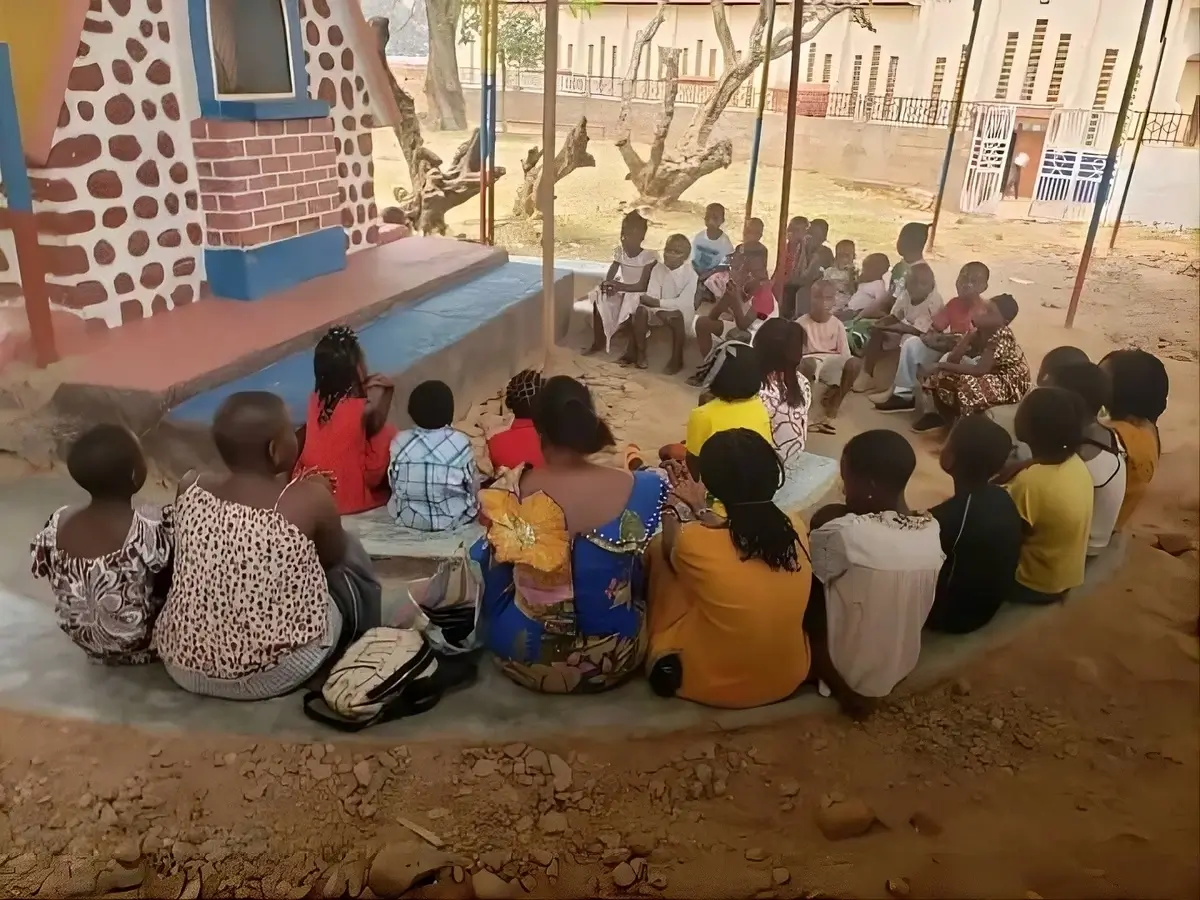
Overemphasizing the reality of war to children really seems to be asking too much for their level. But we must already prepare them with appropriate catechesis, with team games, to help them understand that life is not exclusion, but communion. “One in Christ, united in mission,” as the Holy Father’s message for the missionary month reminds us.
The Virgin Mary and Peace: The group of children of the White Army learn to pair the word ‘army’, which brings to mind a military force that, in our context, instead of providing security and protection, refers to blood; with the innocence and purity they live in their consecration to Our Lady and in the recitation of the Rosary.
Liturgy and Peace: “Anges du Ciel” is a liturgical group where all children are gathered, regardless of tribal origin. They accompany the songs with a few dance steps, but above all, they follow catechesis on cohesion and peace among themselves. They go to school together, do everything with others, and must not take political conflict upon themselves. It seems like an impossible challenge, but we must start from the cradle to heal future generations from the malice that adults can no longer escape.
Long live the mission, long live Peace!
Photo by Don Tacite Mulonda Itulamya