



 Italy
Italy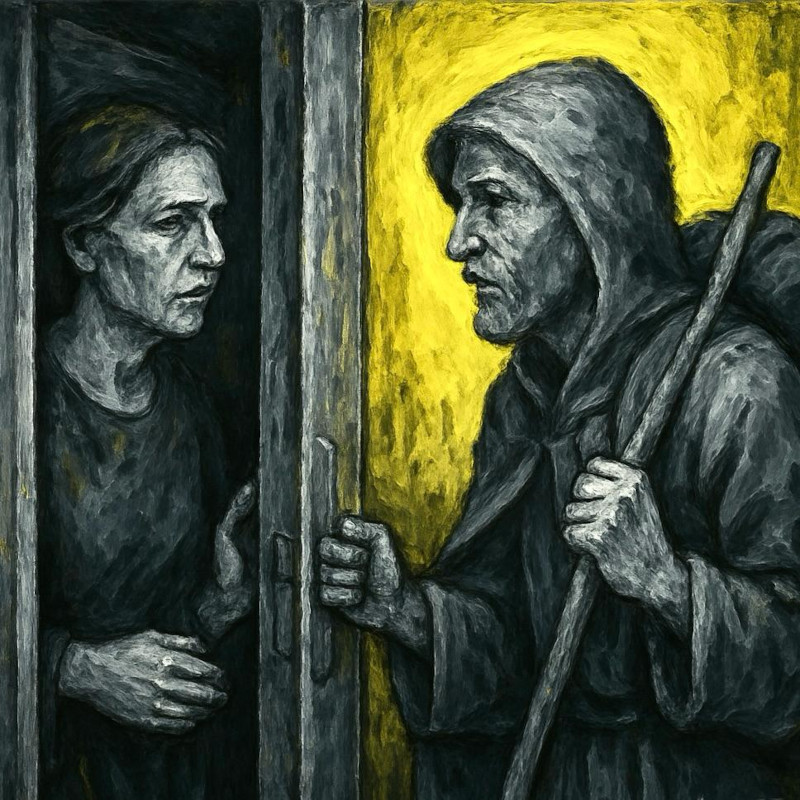
There are at least three fundamental terms in the Hebrew Bible to indicate the “stranger” or “foreigner.” Three terms that help us understand Israel’s progressive maturation regarding welcome:
- The Hebrew word zar indicates the foreigner who lives outside the borders of Israel. Toward this figure, a sense of fear arises. There is a wordplay in Hebrew that allows zar (“foreigner”) to be confused with sar (the “enemy” against whom one must defend oneself). The fear of the stranger therefore has very deep roots in the human heart and is documented by Scripture. This negative consideration of foreign peoples evolves toward more positive tones, especially from the time of the Babylonian exile (around the 6th century BC), when the perception dawns that God entrusts Israel with a mission of salvation for all nations (Is 42:6; 49:6).
- The second term, nokri, is used for the foreigner passing through, who is temporarily among the people for reasons of travel or trade (a sort of “economic migrant”). Toward the nokri there are certain distinctions that still denote distance, but no longer fear (Dt 14:21). Nevertheless, the basic rule is hospitality, typical of Eastern tradition, an hospitality that entails respect and a warm welcome.
- “The third term is gher or toshav and is used for the resident alien living in Israel. This figure enjoys true legal protection, as seen from the earliest legislative texts (Ex 22:20)” (C. M. Martini).
The ceremonial of hospitality
Precise rules existed for hospitality. It had to be generous and extend to travel companions and livestock as well (Gen 24). The greeting was vital: the host prostrated himself with his face to the ground (Gen 19). Washing the feet was not merely a hygienic practice, but served to relieve the guest’s fatigue and refresh them (Gen 24:32).
A guest room had to be provided (2 Kings 4:9-10). The host offered the finest food available (1 Sam 9:22-24). The meal of fellowship created bonds of brotherhood between host and guest, to the point that, in the event of the guest’s murder, the duty of retribution fell upon the host (Gen 19:1-16).
The protection of the foreigner
Denying hospitality is a grave insult (1 Sam 25). The Law given by God to Israel protects the foreigner: woe to anyone who defrauds them of their wages (Dt 24:14)! They enjoy the same Sabbath rest as the Israelites (Ex 20:10). When dedicating the temple, Solomon even prayed that God would answer the prayers of foreigners coming to worship in that very sanctuary (1 Kings 8:41-43).
Reasons for welcoming the foreigner
- The Lord loves the foreigner: the God of the Bible possesses a defining trait: a predilection for the poor. And the foreigner is undeniably “poor,” in a land not their own and lacking legal standing. Israel must protect foreigners because they are loved in a unique way by God: “The Lord… loves the foreigner” (Dt 10:18). And God calls us to love them as He does: “You shall love the foreigner” (Dt 10:19)!
- We are all foreigners: Israel must protect the foreigner because it must never forget having lived as strangers in Egypt. For this reason, God commands that no oppression be inflicted on them: “You shall not wrong a foreigner or oppress him, for you were foreigners in the land of Egypt” (Ex 22:20).
- We are all guests of God: Israel knows it is a guest even in the Promised Land: “for the land is mine, and you reside with me as foreigners and tenants” (Lev 25:23). Christians too are “pàroikoi kaì parepìdemoi”, “strangers and pilgrims” (1 Pet 2:11) dwelling temporarily in this world: “paroikìa” (1 Pet 1:17), from which our word “Parish” derives, comes from “parà oikìa”, “beside the houses”, nomadic travelers passing through.
- The Christological reason: the example of Jesus, who made Himself a guest of humanity and invites all people to be guests in the Father’s house, makes hospitality one of the cardinal virtues of Christian life. The command is unequivocal: “Welcome one another, therefore, just as Christ has welcomed you” (Rom 15:7). During His life, Jesus experienced being rejected: “Mary… gave birth to her firstborn son…, and laid him in a manger, because there was no place for them in the inn” (Lk 2:7); He had to flee as a refugee to Egypt persecuted by Herod (Mt 2:13); and throughout His mission He was frequently turned away (Lk 9:52-56).
The momentous revelation is that Jesus explicitly identifies with anyone in need of shelter: “Whoever welcomes you welcomes me, and whoever welcomes me welcomes the one who sent me” (Mt 10:40). “I was a stranger and you welcomed me” (Mt 25:35): “to express hospitality, Jesus uses here a verb (sunago) whose primary meaning is to gather, to bring together scattered elements. Hence the meaning of gathering those who are lost, welcoming them into the same home, and uniting them with the fellowship of brothers and sisters. This richly evocative verb is recalled three times in Matthew 25. It denotes not just assistance, but genuine welcome” (B. Maggioni). The poor are the living sacrament of Christ: it is in the poor that we encounter Jesus on the roads of life.
Hospitality is a sacred duty for all Christians, commended by all writings of the early Church. Peter in his first letter exhorts to philoxenìa, hospitality, literally “love of strangers” (1 Pet 4:9). Paul invites us to be “eager to practice hospitality” (Rom 12:13). The Letter to the Hebrews reminds us that welcoming a brother is welcoming God: “Do not neglect to show hospitality; for by doing so, some have entertained angels without knowing it” (Heb 13:2; cf. Gen 18:3; 19:2).
- The eschatological reason: the poor and foreigners will be our gatekeepers to Paradise, those who will receive us into celestial dwellings: “Make friends for yourselves by means of dishonest wealth, so that when it runs out, they may welcome you into the eternal homes” (Lk 16:9).
“In «foreigners» the Church sees Christ who «pitches his tent among us» (Jn 1:14) and who «knocks at our door» (Rev 3:20). This encounter – made of care, welcome, sharing, and solidarity, of safeguarding migrants’ rights and of evangelizing commitment – reveals the constant solicitude of the Church, which discovers authentic values in them and considers them a tremendous human resource” (Pontifical Council for the Pastoral Care of Migrants and Itinerant People).
If we fail to offer hospitality to foreigners, we will have failed to welcome Jesus. And we too will enter into the sorrowful company described in John’s Prologue, when it notes with bitterness: “He came to his own, and his own people did not accept him” (Jn 1:11).
Image created digitally by spazio + spadoni



Being Witnesses of Mercy – ILLUMINATE
2 February 2026