



 Italy
Italy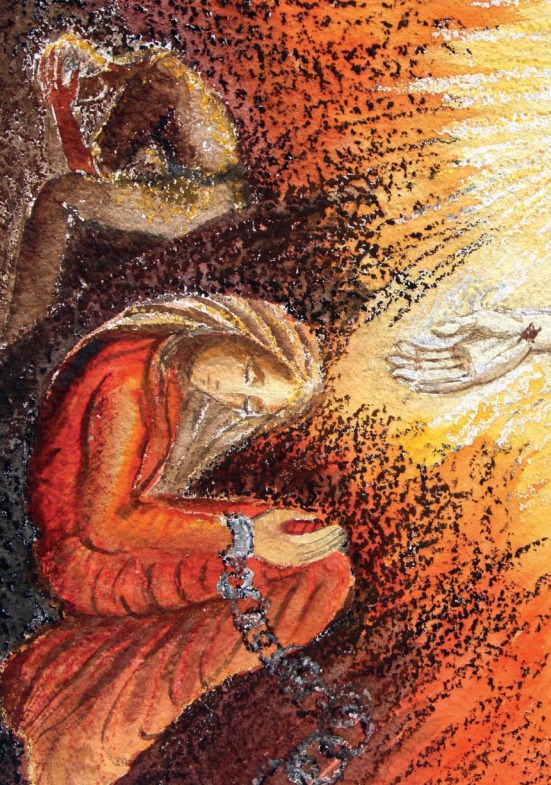
If the history of human violence—an evil so profound, so real—begins with Cain and ends on the Cross; to triumph there is nothing else than the death of God. And if Jesus dies, He chooses to do so between two criminals.
One emerges divinely, going from defeat to absolute victory, the first soul saved by the death of Christ. The other will persist in his refusal of the offered grace.
To understand the work of mercy towards prisoners, we must begin with Jesus’ teaching when He recounts the prayer of the tax collector and the Pharisee (Lk 18:9-14).
Once there were two men: one was a Pharisee and the other was a tax collector. One day they went up to the Temple to pray. The Pharisee stood by himself and prayed this way: “God, I thank you that I am not like other people: robbers, evildoers, adulterers. I am different even from that tax collector. I fast twice a week and give a tenth of all I get.”
The tax collector, however, stood at a distance and would not even look up to heaven. Instead, he beat his breast and said: “God, have mercy on me, a sinner!”. I tell you that this tax collector went home justified before God, whereas the other did not. For everyone who exalts himself will be humbled, and he who humbles himself will be exalted.
The parable begins by highlighting the fact that “being righteous” is never a native condition of the human person; in fact, the Christian is never righteous before God on his own merit.
An excessive assurance of one’s own innocence, especially when it results in a judgmental and intolerant attitude toward others and their mistakes, is something that should give us pause.
The Christian is not defined as a “righteous” man, but rather as a reconciled man, forgiven and justified by God. That is why this parable portrays this contrasting picture between two models: the man who defends his own personal righteousness, which God does not validate, and the man who surrenders before the mercy of God and receives justification.
The case: the story of Jacques Fesch
The prison world is inherently bleak; nevertheless, evil, both physical and moral, can become an opportunity for a serious reconsideration of life. This has happened for many.
I think of the story of Jacques Fesch, a young thief and murderer of our times, born in 1930 and guillotined on October 1, 1957, for having killed a police officer in Paris. Jacques, in solitary confinement, had the chance to conduct a deep examination of his life and gradually rediscovered faith.
He read extensively, especially the Gospels, until he encountered the young Carmelite Thérèse of Lisieux, who became his spiritual guide until the day of his execution.
He wrote tender letters to his partner Pierrette, with whom he had a daughter, Veronique, and whom he married a few days before his death.
During the years of his trial, he met Christ, who can perhaps speak more clearly in the solitude of a cell than anywhere else:
“You too were taken where you did not wish to go,” he wrote in his journal, thinking of Jesus.
At the foot of the Crucifix, he learned, as he wrote, “to accept the cross, which little by little will become light; to offer one’s suffering and the injustices of which one is a victim; to love those who strike us. And so one day I will hear what was said to the good thief on the cross: ‘Truly I tell you, today you will be with me in paradise’”.
“Grace has visited me,” he concluded, “and a great joy took hold of me, and above all a deep peace… It is the first time I weep tears of joy, having the absolute certainty that God has forgiven me.”
On the last night of his life, between September 30 and October 1, 1957, he wrote a moving letter to his daughter “for when she becomes a woman”: “You are so beautiful, Veronique!”. Then came his earthly end, met with peace: “Last day of struggle: tomorrow at this time I will be in heaven! I trust in the love of Jesus and I know He will commission His angels to carry me in their hands.”
The guillotine blade that severed his head actually freed him as a butterfly is freed from its chrysalis. Today, there is even talk of a beatification process for him. With God, solitary confinement can be transformed into a little sanctuary, a broken existence into a path of holiness, and a guillotine blade into a halo of light!
The witness: Don Giuseppe Cafasso (1811-1860)
Confessor to Don Bosco, Don Cafasso dedicated his life to the marginalized and to prisoners.
Pope Benedict said of him: «He knew moral theology, but he knew equally well the situations and hearts of people, whose welfare he took upon himself, like the Good Shepherd. Those who had the grace of being close to him were transformed into good shepherds and valid confessors. He clearly pointed out to all priests the holiness to be attained precisely in pastoral ministry».
He was a constant presence in the Senatorial prisons, often remaining late into the night, sometimes until dawn. He brought cigars and snuff, replacing the lime prisoners scraped from the walls; above all, he brought hardened thieves and murderers to conversion.
These were sometimes slow and agonizing repentances; at other times, they were instant conversions occurring moments before the hanging.
Pope Benedict XVI also stated about him: «From his chair of moral theology, he taught how to be good confessors and spiritual directors, concerned for the true spiritual good of the person, animated by great balance in conveying God’s mercy and, at the same time, an acute and living sense of sin».
Brothers and sisters in prison: the Jubilee, which leads us to encounter a Father who forgives and consoles, can work miracles for all and with all. “Even the time spent in prison,” writes the Pope, “is God’s time and must be lived as such. It is a time to be offered to God as an occasion for truth, humility, expiation, and faith. The Jubilee experience, even in prison, can lead to unexpected human and spiritual horizons” (Cardinal Gualtiero Bassetti, Archbishop Emeritus of Perugia).
Prayer of Paul VI
We need You, O our Redeemer, to uncover our misery and to heal it; to grasp the concept of good and evil and the hope of holiness; to deplore our sins, especially when children are the victims, and to obtain their forgiveness.
We need You, O great Patient of our sorrows, to know the meaning of suffering, exploitation, and violence, and to give them a value of expiation and redemption.
We need You, O Christ, O Lord, O God with us, to walk in the joy and strength of Your charity, until the final encounter with You, the Beloved, the Awaited, the Blessed forever and ever. Amen.
Illustration by Sister Marie-Anastasia Carré (Communauté des Béatitudes)
Being Witnesses of Mercy – ILLUMINATE
2 February 2026