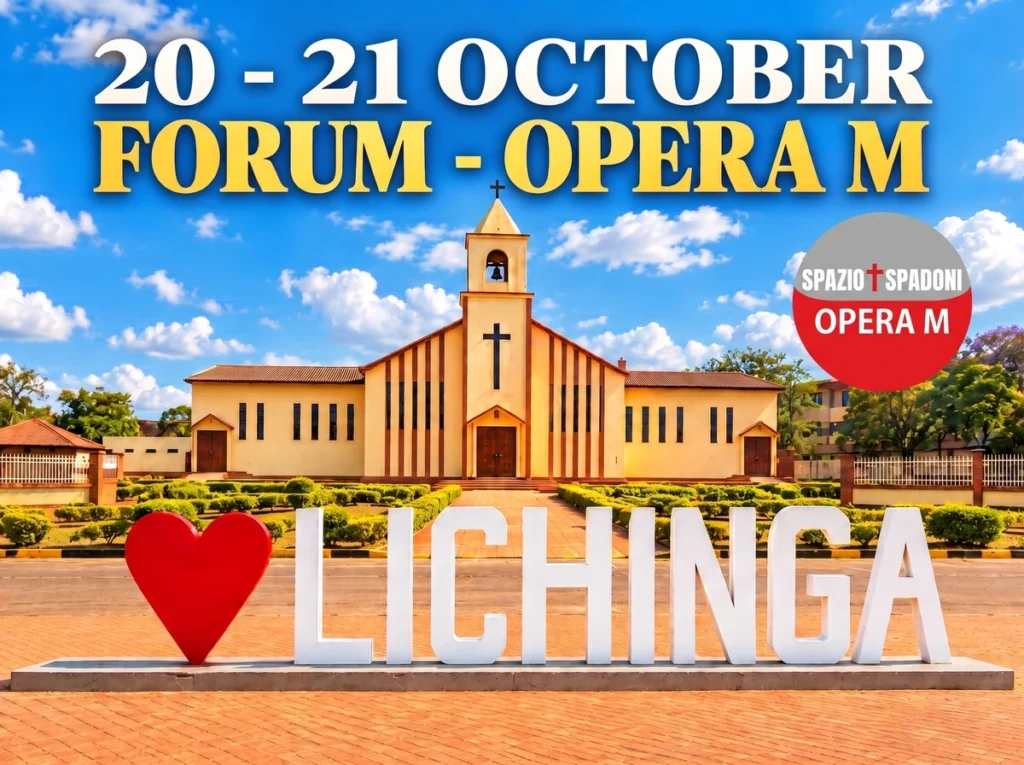


The 50 ongoing HIC SUM projects

Sister Jacqueline
DR Congo
Misericordia Santa Gemma Galgani
Missionary Congr. Sisters of Saint Gemma

Sister Beatrice
Nigeria
Misericordia Villa Adriana
Handmaids of the Holy Child Jesus
Sister Lizia
Brazil
Misericordia Lucca
Sisters Daughters of Saint Francis de Sales

Sister Ernestina
Nigeria
Misericordia San Francesco di Massa
Handmaids of the Holy Child Jesus

Sister Justina
Nigeria
Misericordia Castelnuovo Garfagnana
Handmaids of the Holy Child Jesus
Sister Rolande
Togo
spazio + spadoni
Sisters of Our Lady of the Trinity
Sister Margaret
Nigeria
Misericordia Bivigliano
Handmaids of the Holy Child Jesus

Sister Latha
India
Misericordia di Anghiari
Franciscan Sisters of St. Thomas
Lazzarino Placentino
Ivory Coast
Misericordia Marlia
Missionary Congregation Sisters of Saint Gemma
Sister Hyacinthe
Burundi
Misericordia Sansepolcro
Congrégation des Sœurs du Cœur Immaculé de Marie – Suore Bene Mariya
Mirian Aguilar
Peru
Misericordia Sarteano
Sisters of Mary Immaculate – Claretian Missionaries
Sister Marie Louise
Kenya
Misericordia di Viareggio
Sisters Ministers of the Sick of Saint Camillus

Sister Maria
Nigeria
Misericordia Firenzuola
Handmaids of the Holy Child Jesus
Sister Alice
Burundi
Misericordia Monte San Savino
Congrégation des Sœurs du Cœur Immaculé de Marie – Suore Bene Mariya
Sister Lea
Burundi
Misericordia Arezzo
Congrégation des Sœurs du Cœur Immaculé de Marie – Suore Bene Mariya
Sister Perpetue
DR Congo
Misericordia Orta Nova
Sœurs Dominicaines Filles de Sainte Catherine de Sienne

Sister Elisabeth
DR Congo
Misericordia Alfero
Petites Sœurs de l’Evangélisation

Sister Marguerite and Sister Angele
DR Congo
Misericordia Borgo a Mozzano
Soeurs Dominicaines Missionnaires des Familles
Sister Perla and Sister Angelica
Mexico
Misericordia Rosolini
Misioneras Catequistas de los Sagrados Corazones de Jesús y de María
Sister Filipina
Tanzania
Misericordia Acireale
Immaculate Heart of Mary Sisters of Morogoro
Sister Devotha
Tanzania
Misericordia Roccasecca
Holy Spirit Sisters
Sister Oliver
Tanzania
Misericordia Monte San Giovanni Campano
Holy Spirit Sisters
Sister Adele
DR Congo
Misericordia di Assisi
Religieuses de la Sainte Famille d’Helmet
in progress
Syria
Sister Christine
Uganda
Misericordia Canosa di Puglia
Sisters of Our Lady of Good Counsel
Sister Joan
Kenya
Misericordia di Orta Nova
Sisters of St. Joseph
Sister Agnes
Rwanda
Misericordia di Stiava
Fraternité des Consacres de la Communauté Ingoro Y’Urukundo (Demeure de la Charité)

Sister Annie
DR Congo
Misericordia di Assisi
Soeurs de la Sainte Famille de Kisangani
Sister Anjeline
Tanzania
Misericordia di Roma San Romano
Adorer Missionary Sisters of the Poor
Sister Odette
Burkina Faso
spazio + spadoni
Sœurs de l’Immaculée Conception de Ouagadougou (SIC)
Sister Evarest
India
Misericordia di Camaiore e Lido
The Sisters of the Sacred Heart of Jesus

Sister Ansila
East Timor
Misericordia Borgo a Mozzano
Institute of the Daughters of Saint Francis
Sister Marie Jacqueline
DR Congo
Misericordia di Villanova Monteleone
Sœurs Servantes de Jésus
Sister Clemence
DR Congo
Misericordia di Villanova Monteleone
Petites Sœurs de l’Evangélisation
Sister Lumintaha
Rwanda
Misericordia di Uzzano
Fraternité des Consacres de la Communauté Ingoro Y’Urukundo (Demeure de la Charité)
Sister Andrea
Philippines
Misericordia di Marlia
Sisters Daughters of Saint Francis de Sales
Sister Leah
Tanzania
Misericordia di Castiglione del Lago
African Benedictine Sisters of Ndanda
Sister Zitha
Tanzania
Misericordia di Fossato di Vico
Congrégation des Sœurs du Cœur Immaculé de Marie – Suore Bene Mariya
Sister Yvette and Sister Caroline
DR Congo
Misericordia Ponente Soccorso
Sœurs de Jésus Educateur
Sister Maria
Tanzania
Misericordia di Valledolmo
Disciples of the Redeemer in the Christians of the World Community
Sister Milia
Tanzania
Parrocchia di San Michele in Guamo
Sisters of St. Joseph
Sister Francine
Democratic Republic of the Congo
Comunità Parrocchiale Santa Gemma
Religieuses de l’Instruction Chrétienne
Sister Esther and Sister Yolande
Madagascar
Misericordia Adrano
Congregation of the Sacred Heart of Jesus of Ragusa
Sister Kahongya (Suor Marie Louise)
Democratic Republic of the Congo
Misericordia Portopalo di Capo Passero
Petites Soeurs de la Présentation de Marie au Temple
Sister Theresa
Nigeria
Misericordia Adrano e Misericordia Bompietro
Congregation of the Sacred Heart of Jesus of Ragusa
Sister Blandina
Malawi
Fondazione | RSA SS. Annunziata
Presentation of the Virgin Mary Sisters
Sister Rodha
Indonesia
Associazione “Tutto è Vita ONLUS” – I Ricostruttori
Carmelite Missionary Sisters of Saint Thérèse of the Child Jesus
Sister Rachelle
Benin
Misericordia Orta Nova
Institut des Servantes de la Lumière du Christ
What is HIC SUM?

The HIC SUM missionary project combines thought and action, emphasizing the profound and essential value embodied in the voluntary act. The goal is to launch 72 HIC SUM projects worldwide.
The HIC SUM project (a Latin expression meaning “HERE I AM”) is at the heart of spazio + spadoni’s activities.
Embarking on this journey means being aware of a responsible choice with amissionary character: opening our arms and making ourselves available to be bearers and witnesses of the Word and Love of the Lord, and therefore of His Mercy.
 italiano
 français
 english
 español
How HIC SUM works
Spazio Spadoni establishes contact with an Association and a Congregation women’s missionary religious congregation. A sister from the Global South comes to Italy for a training and work-experience period lasting from 3 to 12 months with the Association; her presence also becomes a “sign” among the volunteers and within the community.
The sister undertaking her training in Italy is supported by a tutor (appointed within the Association) and follows a structured support plan provided by the Spazio Spadoni staff. This makes the journey a genuine accompaniment, both while learning technical and organizational processes and in managing human relationships.
Once her experience in Italy is complete, the sister returns to the mission country and lays the foundations for a new local Association, made up of volunteers who, with a spirit of generosity, fraternity, and love, carry out at least one of the 14 Works of Mercy. From the outset, an ongoing exchange of volunteers is fostered between Italy and the mission location, and vice versa. A true partnership develops between the Italian Association and the one founded in the mission, which must be
nurtured and developed.
In the mission country, the hope is also to establish a Social Enterprise called “Il Pane di Misericordia”, producing a food used by the local community (bread, rice, chocolate, honey, etc.) or developing and strengthening farming or livestock activities. Some of the resulting goods will be sold to generate income for self-sufficiency and social advancement, while the rest will be donated to the poor according to each Congregation’s charism. This is a tangible sign of the Work of Mercy “Feed the hungry”.
For the first five years, the project is fully supervised and supported by Spazio Spadoni, covering its financial needs as well as promoting and coordinating its operational phases. After this period, Spazio Spadoni continues to supervise and assist the project, while the Italian Association takes the leading role in supporting and developing its partner mission in the Global South.
SisterChain HIC SUM – Circular Funding for Communities of Sisters
Model Objective
The SisterChain model is designed to create a cycle of financial support among small businesses managed by communities of sisters. The cycle begins with a donor funder (spazio + spadoni), which provides the initial funds to launch the first business. Using the profits it generates, the business supports another community of sisters, starting a virtuous cycle that fosters economic development and sustainability among the communities.
Funding Model Structure
- Phase 1 – Donor Funder
The cycle begins with a donor funder ( spazio + spadoni), which provides the initial funds to launch Business A. spazio + spadoni commits to supporting the creation of a social enterprise managed by sisters that will not only generate income for the community but will subsequently support other religious enterprises.
Initial Funding Example: an amount of € 100, sufficient to cover the start-up costs and initial operating phases of Business A. - Phase 2 – Business A. Profit Generation
Business A is a small business managed by the community of sisters. Its activities may involve craft or agricultural production, or social services. Its main objective is to generate sustainable profits for the community, covering both operating costs and community needs, while allocating part of the profits to fund another religious enterprise belonging to the same congregation.
Business A Example- Sector: Bakery or honey production
- Annual profits: € 55
- Percentage of profits allocated to funding Business B: 30% ( € 16.5 )
- Phase 3 – Business B. Funding and Growth
Business B is a second business managed by another community of sisters. The profits generated by Business A are used to fund Business B. In turn, Business B begins to develop thanks to the capital it receives and commits to allocating part of its profits to launch another religious enterprise belonging to the same congregation (Business C).
Business B Example- Sector: Tailoring workshop or candle production
- Community B or congregation capital € 50
- Initial capital received: € 16.5
- Capital received through 2 additional funding payments from Business A over 2 years, totaling € 49.5
- Annual profits in subsequent years: € 25
- Percentage of profits allocated to funding Business C: 30% .
- Phase 4 – Business C. New Funding
Business C is the third business in the cycle. Once Business B is established and generating profits, part of these funds is reinvested in Business C, continuing the cycle of support among religious communities.
Business C Example- Sector: Organic farming or natural beauty products
- Community C or congregation capital
- Capital received from community B: € 49.5
- Repayment and reinvestment: Business C commits to allocating part of its future profits to funding a new religious enterprise
- Phase 5 – Development and Support Cycle
Once the cycle is underway, each business generates profits that are partly reinvested to fund new initiatives. The cycle continues to expand, creating a network of sustainable businesses that strengthens the economic self-sufficiency of communities of sisters.
Role of the Donor Funder
As the initial donor funder, spazio + spadoni plays a key role in creating the cycle by providing the capital needed to start the process. Once underway, the SisterChain model becomes self-sufficient, as the funded businesses continue to generate and reinvest profits in new businesses. The donor funder may continue to support the cycle with new donations or contribute only at the outset, allowing the cycle to continue independently.
Model Benefits
- Economic Sustainability
The model creates an ecosystem of self-sufficient businesses that not only generate profits for the community but also reinvest those profits to support other businesses. - Social and Community Impact
Each business not only contributes to the local economy but also provides goods or services that meet community needs, such as food products or clothing. - Multiplier Effect
A single initial donation can have a lasting impact, creating a chain of businesses that continue to grow and fund other communities. - Community Autonomy
The sisters become financially independent and able to sustain their communities as well as their social and religious missions, without relying exclusively on ongoing donations or the motherhouse. - A Model to Share with the World
italiano françaisWhy 72 HIC SUM projects? 72 DISCIPLES (Lk 10:1)
When reading the Bible, it is important to remember that all its numbers have a symbolic rather than strictly objective value.
Chapter ten of the Book of Genesis (Gen 10:1–32) presents the “Table of Nations”, namely the list of Peoples created by God.
The forefathers of all the nations number 70, a perfect multiple of 7, the sacred number par excellence (7×10). There are fourteen descendants of Japheth, thirty-one of Ham, and twenty-five of Shem. Shem, Ham, and Japheth are Noah’s three sons.
Jewish exegesis developed an extensive theology around the number 70. The Rabbis state that, because of this division, God created 69 Angels of the Nations, reserving Israel for Himself (69 +1 = 70). To honor this number, God is said to have proclaimed the Law in 70 languages on Mount Sinai and commanded the Priests to offer 70 burnt offerings during the Feast of Tabernacles (2 Chr 29:32). By analogy, the descendants of Jacob, ancestor of the holy people, numbered 70 (Gen 46:27; Ex 1:15). There are likewise 70 Elders in the wilderness (Ex 24:1), 70 kings defeated by Adoni-Bezek (Jgs 1:7), 70 sons of Gideon (Jgs 8:30), 70 sons of Ahab (2 Kgs 10:1), and 70 Elders of the house of Israel (Num 11:16). The number 70 is therefore also the symbolic number of an ideal family, both on earth and in heaven. The same applies in non-Jewish traditions: the Pantheon of Ugarit, capital of the ancient Kingdom in Syria, lists 70 children of the deities ‘El and Aserah (II, AB VI, 46).
“This system, which to us Westerners might seem like a game, revealed to Semitic readers the harmonies of number and unity of composition” (P. E. Testa).
The Greek translation of the Bible, known as the Septuagint, instead speaks of the creation of 72 peoples.
According to tradition, the Egyptian ruler Ptolemy II Philadelphus, who reigned from 285 to 246 BC, personally commissioned the religious authorities of the Temple in Jerusalem to produce a Greek translation of the Pentateuch for the newly founded Library of Alexandria. After the Babylonian exile, the Jews no longer understood Hebrew, whereas Greek had become the international language, much as English is today. The high priest Eleazar appointed 72 Jewish scholars—six scribes from each of the twelve tribes of Israel (simplified to 70 in some later accounts)—who travelled to Alexandria and were
warmly welcomed by the ruler. After settling on the island of Pharos, they completed the translation in 72 days through their shared work.
In any event, “it was the Greek Bible that Luke had at his disposal when writing his Gospel” (O. Da Spinetoli): the Bible that states that the peoples created by God number 72. Luke therefore writes: “After this the Lord appointed seventy-two others and sent them on ahead of him, two by two, into every town and place where he himself intended to go” (Lk 10:1).
In fact, the Elders of Israel upon whom the Spirit of God descends also number 72, because Eldad and Medad, who remained in the camp, must be added to the 70 Elders gathered in the Tent of Meeting (Num 11:25–26), as the Zohar—the most important book in the Kabbalistic tradition—consistently emphasizes.
It is also worth noting that, according to gematria—the Jewish theological discipline that assigns a numerical value to each letter—the number 72 corresponds to the name of God (IHWH). The same principle existed in the Latin world, where numbers were represented by letters: adding the values of the individual letters produces a number that in turn defines a person or thing.
Thus, the number 72 is both a symbol of universality and a reference to the holy Name of God Himself.
According to Jewish symbolism, the disciples are therefore sent to evangelize all peoples. “Beyond the question of whether there are 70 or 72, the meaning is clear: the Word given to Israel must reach all God’s children, all peoples. And 72 (the peoples) plus 12 (the tribes of Israel) equals 84, that is, 7 times 12: the totality (7) of humanity is the people of God (12)!” (S. Fausti).
Even a simple numerical value can reveal marvelous insights to those who explore Sacred Scripture with love and passion…
Carlo Miglietta – biblical scholar
The 50 HIC SUM projects worldwide
faq
HIC SUM is the missionary project that expresses the heart of spazio + spadoni.
“Hic sum” means Here I am: a free and responsible response to the call of mercy, lived through tangible, shared choices.
To launch 72 mercy projects worldwide, capable of generating communities, works, relationships, and self-sufficiency, in the Gospel spirit of the 14 Works of Mercy.
The project stems from the partnership between:
– an Italian Association
– a women’s missionary religious Congregation
– coordination by spazio + spadoni.
A sister from the Global South spends a period of training and work experience in Italy (from 3 to 12 months), becoming a living presence within the community.
The sister is supported by:
– a tutor appointed within the Association
– a support program structured by spazio + spadoni.
This support covers both operational aspects and the relational and human dimension.
The sister founds a new local Association, made up of people who live out at least one of the 14 Works of Mercy.
A lasting partnership is established between the Italian Association and the one in the mission.
It is a Social Enterprise that produces an essential good for the local community.
One part supports self-sufficiency, while another is donated to the poor as a tangible sign of the Work of Mercy Feed the hungry.
The number 72 recalls:
– the 72 disciples sent by Jesus (Lk 10:1),
– the universality of peoples according to biblical tradition,
– the holy Name of God in Jewish gematria.
It symbolizes mission, universality, and the spreading of the Word.
Associations, communities, congregations, and people who wish to embrace mercy as a choice of life and witness.